
Subhas Mitra:
Culture and customs (C&C) mature into tradition and Heritage, only when it stands on their base belief system i.e. foundation. It helps one to form an opinion on newness. According to one’s cultural background, only one interprets new inputs. Cultural interexchange helps improve the adoption of new or discarding what is unworthy and old.
But this is true only when the foundation is strong enough. With the change of foundation (religion), C&C becomes a farce and the newness takes centuries to become tradition and heritage. Hindus of Bengal seem to have damaged their foundation for pursuing modern and up-to-date life without trying to understand the concept of C&C innovation or renovation.
Buddhism, Islam, and Christianity entered Bengal, and Proselytism (exodus from Hinduism) started, but as the C&C of new entrants were not matching or coping with native C&C, the converts were to adopt their propagators C&C (albeit partially). Non-converts i.e. Hindus, on the other hand, faced all-around pressure and discrimination despite being the majority. British were cleverer and they made us a minority during their rule. Without giving up the foundation, Hindus resorted to pretending or adopting the C&C of invaders to go close to the invader’s favorite people around them.
In the race of going close to ‘Masters’, the non-converts started damaging their C&C and foundation itself.
They became (brown) Sahib, Babu, secularists, communists, and anarchists and turned into selfish introverts and mean-minded who are careless about their tradition and heritage. They have lost a sense of obligation towards their C&C and GenX.
Who ruled Bengal:-
Pala dynasty of Buddhist rule:
From 750 AD to – Govindapala – 1155–1159 AD
Sen Dynasty, Hindu rules:
Hemanta Sena (1070–1096) to Keshava Sena (1225–1230)
Muhammad bin Bakhtiyar Khalji
1204– (1212 took control), the Islamic rule begins and continues till today.
(Figures are from R C Majumder – V-I).
The Communist Party was formed in 1925 i.e. If in 95 years they can do what we see today, have we given a thought as to how “Bong psyche” has undergone during 409 Budd +541Muslm + 296 Chris = 1246 years of “ANTI HINDU”/ Hindu suppressing rule in Bengal? Some scholars do not believe that Buddhist rule was anti-Hindu but I think they could have not been better than Nehruvian / communist Hindu rule.
But how did we survive?
May be Bodu Chandidas effects:
Was an intellectual product of 409+ years of absolute Buddhist rule that controlled education, Literature, and broke the Hindu social order (Varna system). He experienced the effect of some 165 years of Hindu rule that had to import Brahman, Kayasth, Rajput ( Ugra Kshatriyas of western Bengal), sweepers, etc. He was born during Muslim Rule and witness how Muslims were being increased by invaders who condemned anything native including Indic languages in general and Sanskrit in particular.
It would be futile to talk further without discussing “ Charyapad “ (চর্যাপদ) or CP. CP is a Buddhist ideology propagating literature with the Bhakti narrative of Nirvana, the nothingness. Buddhism was the trendsetter to weaken Hinduism as it is a Nastika school that rejects the authority of the Vedas.
I have not studied Charyapad (CP) to the extent to form an independent opinion but Philologist Suniti Kumar Chattopadhyay noted that Bankim Chandra, Tagor, Begum Rokeya, Mir Musharaf Hussain, Sarat Chandra, Upendra Kishore Roy Choudhury, Humayun Ahmed, Md Abdul Hai, Anwar Pasa were some of the eminent writer/ thinkers who were inspired by CP and written on CP. . They believed that CP set the base tone of Bangla literary inspiration.
Hara Prasad Sastri, Shasibhushan Das Gupta, and Ashim Bandhopadya insisted that CP was Buddhist religious storytelling. Fiction writing also has its beginning in the CP era.
Though Buddhists tried to bypass Sanskrit but between 11th to 13th centuries Sanskrit could not be replaced but changed the script which is said to be the origin of Bangla (see images like Nidanpuri script etc.) but the vocabulary was such that Assamese and Oriya too were accommodated. Language at this stage was called sandhya or Twilight language (Ref: Suniti Kumar Chattopadhyay).
“Buddhists were for unifying Indic languages while Abrahamic tried for linguistic disintegration of Hindu society”. CP is the first disintegration attempt for local people from Sanskrit; Muslims wrote Bangla to propagate Islamic vocabularies to locals (including converts as there was no Urdu then) while the British gave the First printed book in Bangla, a Bible.
The language of CHARYAPADA used lipi (script) that was not fully developed but both Hindus and Muslims accept it as the base of Bengali literature. Modern Bangla fiction writing however starts in 1860.
Summary of the Effects on C&C of non-converts:
- Buddhists tried to weaken Hindus by disconnecting Hinduism from its source, the Vedas.
- Sufis, with their experience in converting Hindus without blood baths in Sindh, Multan, and Punjab started makeshift camps (called Khanque or khank) in Hindu villages to convert the masses without a blood bath. Perhaps it was then Satyanaran, Satya Pir, Manik Pir, etc. infused in Hindu society and confused commoners and drove Hindus of higher understanding away from Vedas.
- Protestants introduced Theosophical society to put intellectual and worthy Hindus in a new dilemma by claiming “God did not create Man but Man created God- Jiddu Krishnamurthy, the adopted son of Annie Besant.
- Catholics were engaged by the British to resort to INCULTURITION by which Christian monotheism was implanted in the Hindu psyche through education, discourses, or Brahma Samaj – taking learned Hindus away from Dvaita- Advaita concept.
THE CENTRAL THEME OF ALL the 4 was to penetrate in “Hindu psyche” by condemning Hinduism and praising Atheism. Hindus felt happy that the British are not forcing conversion. It is atheism that makes any cultural foundation hollow, weak, and feeble and leads to destruction from within.
Did Chandidas save Hinduism in Bengal via atheism?
Before I proceed, let me draw a picture of Muslims in Bengal. Muslims have their Shia-Sunni type 9 major sects, 73 firqa, 4 schools of Jurisprudence and 332 castes (in the Indian subcontinent), and FOUR schools of interpretations. Bengal was no different. But the main difference was Ashrafi (foreign origin) and Ajlaf (native converts i.e. ex Buddhists and Ex- Hindus). Badu Chndidas effect was able to penetrate such psyche itself, which was a great achievement in my eyes.
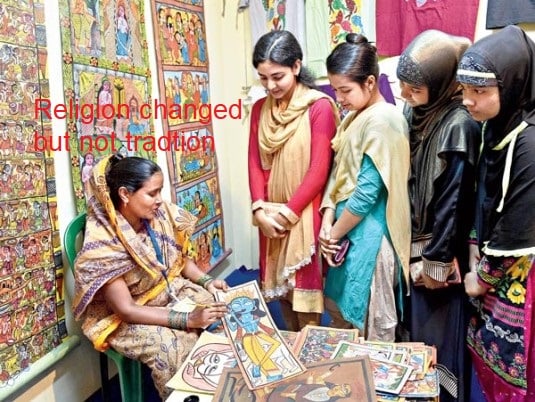
Ali Riaz, of Illinois State University, says the policies of British colonial rule (1757—1947) made the most indelible marks on madrassa education directly and indirectly involving the Ulema and the Muslim community in madrassa education.
The Moroccan traveler Ibn Batuta writes of 13 madrasas, which were operational in India during Firuz Shah Tughlaq (1309-1388 CE). But they were for Ashraf. Altaf (ex-Hindus) was not allowed.
Even Sultan Ghiyasuddin Balban (1266-1287) followed a strict policy of keeping out ‘low caste’ (Arzal- converted downtrodden) Muslims from any post in his administration.
Cultural fusion during Turk rule in Bengal:
Classical Arabic had three long and three short vowels, and Turkish has eight. Turk uses Arabic /Persian script but they maintained their linguistic identity. Early Muslim writers of Bengal preferred Arabic/Persian to Turk thus how much of C&C exchanges took place is very difficult for me to assess.
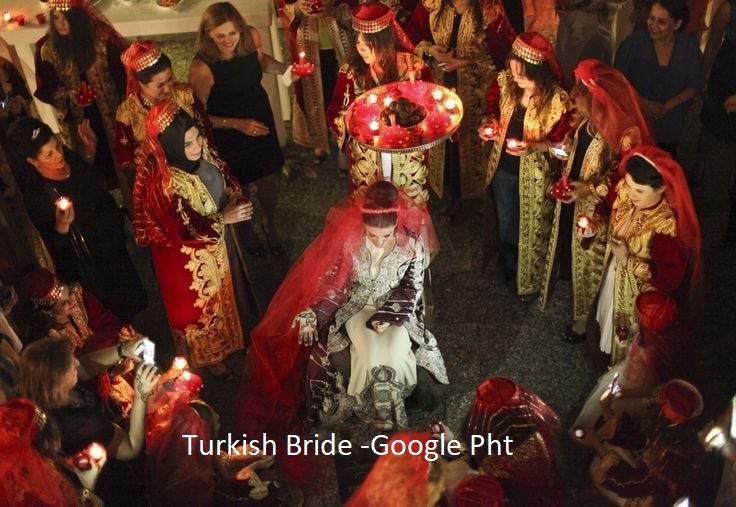
On the Cultural front, I do not read any cultural exchanges but some claims, Hindus took Turk’s wedding rituals as Bride and Groom’s headgear, red color bride dress, hide and seek of a coin in Milk or Rice, ceremonial turmeric bath and obstructing sight between bride and groom during the ritual have similarities. Hindu weddings are as per Vedic guidelines and vary with regional customs. Turk ruled Arabia for 400 years but no similarities with such wedding rituals is known to me. Doesn’t that mean Turk might have taken from Hindus? There are examples of Hindu Kings deceived through the marriage of their offspring to Muslim rulers and subsequently converted. Could be it has gone through that route.
I cannot give any authentic account but I have seen in my childhood at my village the following:
- First thing was to discard all Hindu C&C.
- Replace bronze utensils with Aluminum / clay.
- Replace gold jewelries with silver or other
- Rap Sari from right shoulder instead of left.
- Carry water or Baby on right armpit (waist) instead of left.
An AJM teacher of our school told that there used to be unofficial whispering among New Converts that do everything opposite of how a Hindu does. He also said Hindus adopted Lungi, Pajam, and Punjabi from Muslims.
1. I call Ashrafis and pro-Ashrafi Muslims “ASM” Present-day Urdu & Pakistan lovers.
2. Ajlaf Muslim as AJM (those who used Bangla and did not discard local C&C in totality.)
We know Pandit convert Alama Iqbal had to once use harsh words to ASM- “Forget not it is Brahman’s blood that flows in my vain”. This was when Urdu was there but in Bengal, AJM thinkers used the same Sanskrit-based Bangla as there was no Urdu and the ASM Rulers used Persian, Turk, etc., and Arabic in Mosque/Madrasa.
During 1690s Bengali poet Abdul Hakim, an AJM from Chittagong wrote:
যেসব বঙ্গেত জন্মি হিংসে বঙ্গবাণী
সেসব কাহার জন্ম নির্ণয় না জানি
দেশী ভাষা বিদ্যা যার মনে ন জুয়ায়
Whoever hates the verses of the Bangla being born in the soil of the land?
It is unknown determine the essence of their birth
He, who is not satisfied with his language and learning,
— Translated by Jahangir S. Dickens [3]
What ushered in the era of Cultural permeability in Bengal?
Jinnah ate pork, was an alcoholic, and had extramarital affairs but no seminaries or Ummah excommunicated him. Why? Such Haram becomes Halal if done for an Islamic cause. Similarly, those Muslims who returned to Hindu culture (during Chaitanya Mahaprabhu and/or Pir Ali Brahmans) were not excommunicated because they were confident of their “theocratic hold” but Hindus did not have any such theocratic institution. Thus Islamic tenets could be easily infused into Hindu psych. It is like tailgating or piggybacking someone through an open unauthorized door.
Hindus kept the window open to let in the fresh air but did not feel the need to close it when poison/pollution started coming in.
Thus it can be assumed that “Chandidas” brought Hindu and AJM on one literary and intellectual platform to prevent pollution (hatred). It was during this era that AJM once again took part in native festivities ( Mansha, Sitala, Ban Devi, Ban Bibi etc. a British survey officer Lieutenant Richard Eton wrote). He wrote Baul songs with traditional CP (চর্যাপদ), Vaishnav folk songs, Kirtan, Path Kotha পঠকথা ( Ramayan, Mahabharat, Puran storytelling with picture). This still exists in villages of both Bengal (you can surf and find Muslim Kirtaniya( Hindu devotional song) on YouTube even today). We know a Dhrupod (Vedic recitation tradition) singer converted family recites Gayatri (Hindu scripture) at Brahma muhurta, followed by morning Namz. This is not acceptable by ASM.
When the British came we had 65.5% Hindus in Bengal, by 1946 we became 46%. I earlier blamed the British but now I find it is besides Brit, there could be other factors. The church might have kept Hindus busy with Hindu Renascence; Muslims kept increasing so that they could concentrate on NEFA for mass Christianization quietly in North East.
Suhrawardy / Jinnah was AJM but lived a life of ASM while Fazlul Haque was AJM. Hindus never looked at them from this angle while they sing the divide and rule policies of the Bible, propagated by the British. Neither CR Das nor Netaji Subhas Chandra Bose tried to capitalize on this from 1905 onward consistently. If Netaji instead of going with the ASM Muslim league went with Zajlul Haque –Shyamaprassad, the future of Bengal would have been different. Rashbehari Bose’s dream of undivided Bangla with 54% Muslims too might have taken a different course.
Turk ruled Bengal from 1212 to 1757 but no Bengalis, not even converts adopted Turk but Christian Britain ruled from 1757 to 1947, and English knowing Hindus became Anglicized Deshi Ungrej.
Bangladesh’s Rapid Strides in the economy, education, social status, and standard of living compared to Pakistan could be attributable to the Chandidas effects. Bangladeshis have overcome their identity crisis in Pakistan still unable to come out. Urdu is banned and is taught formally in Bangladesh in the department of Urdu, University of Dhaka. BA, MA MPhil, and Ph.D. degrees are offered. But some bloggers from there write a trend of teaching ONLY Urdu in many private Madrassas. Some people doubt that they are preparing infiltrators in India for Ghaz a Hind; some believe Pakistan trying to make a sympathizer. However, Bangladeshis are progressive, modern patriots with Islamic values close to their hearts. Their population growth rate came under control, (not by law or Islamic lecture but by literary and change in cultural outlook). If they can gain control over their ASM population, Madrassa-educated Jihadi units, and Islamic mercenaries, WB Hindus will lose whatever credentials they have today.
If the situation does not change shortly, Bangladeshis will turn these so-called liberal, broad minded, beef eating Hindus into their Puppets. No amount of Muslim vote bank will help WB Hindus.
 subhasmitra.co.in
You must be logged in to post a comment.