
Subhas Mitra: 02 July 2022
Afterlife comes after death and all are afraid of death to the varying extent that appears as love for life/living. The inhabitable death has various definitions.
Psychology of death:
We do know what is biological death but psychological death? Yes, psychologists want us to know that there are different emotional responses that people go through in response to the knowledge of death.
When Psychological death occurs they may be less interested in normal activities, world events, and social relationships.
Fear of Death:
Thanatophobia is an intense fear of death. But universally speaking some understand death as the ultimate truth but most of us are afraid of it simply because it takes away our worldly affairs thus it is a fear of losing. Those who are suffering might love to die to escape suffering.
I often wonder how Army or Terror groups train suicide squads.
I spent some time understanding the secret of this love for DEATH. How do various ancient civilizations look at life “BEFORE” and “AFTER” death? Is there anything called spiritual death outside SAMADHI (unification of mind) of Vedic religions? I could not find but I found Death in Islam is the termination of worldly life and the beginning of the afterlife.
Modern men’s dilemma:
Commoners fail to understand that some people love DEATH under certain situations for desired afterlife rewards. Vedic do not have a theocratic setup, thus they do not know that Abrahamic people live a public & private life which is different from their theocratic life.
The western world does not allow Convent schools to teach children that the flat world was created THREE days before the Sun was created just 4000 years before God sent His Son.
But in Indian English Madrassa (Convents) have it with some twist and turn. Many in India do not know the difference between Church (Convent) education and western modern education.
Saudi Arabia is a country where The Koran is a constitution but Faisal bin Abdul-Aziz Al Saud (14 April 1906 – 25 March 1975), a statesman and diplomat who was the King from 2 November 1964 until his assassination in 1975. He is said to have outsourced Strict Islamic Madrassa to Pakistan and he brought modernization to the Saudi Education system. South Korea failed to identify the difference between “Church education” and “western education” and they damaged their native culture but Saudi never invited Christian missionaries. Now they have a 30 years plan for further modernization.
Muslims in the subcontinent including secular India are encouraged to attend Madrassa. Just see an image from an Indonesian school teaching.
UAE, Qatar, Oman, and Bahrain have Hindu Temples and no one dares to desecrate and demolish the way some Muslims of subcontinents want to.
What an irony – Saudi Arabian schools teach Ramayana- Mahabharata but not India. Bangladesh has a unique education system under which Hindus are given Hindu religious education in academics but still, a section of Muslim youth keeps Koran at a ‘Puja pandal’( Hindu altar) and start nationwide massacre of their forefather (Hindus).
Could this be an ‘afterlife’ attraction?
What is the afterlife?
The afterlife is a purported existence in which the essential part of an individual’s identity or their stream of consciousness continues to live after the death of their physical body. Belief in an afterlife is in contrast to the belief in oblivion after death / Nirvana.
Learning swimming could be the best way to overcome Hydrophobia But for a Muslim LIFE is a transition through surrender to Allah and prayer. Comply with those FIVE pillars. In the end, say ‘We were unaware that ‘It was our ancestors who worshipped others besides Allah and we are only their descendants. Will, you then destroy us for what those liars did?”
: (Qur’an, 7:172-173) and then die for the “greatest rewards” after death.
Their other TWO divine brothers (Jews & Christians) do not have such rewards nor have they to give an affidavit that their forefathers were idolaters or liars. These TWO Abrahamic and all civilizations, they have destroyed, including Hinduism do have “love for life” and “FEAR of Death”.
Fire, wheel to the internet, space tourism to health care are created out of love for life & fear of death but think when one is living for rewards after death, what could be such a person’s contribution to society.
Life beyond DEATH in various civilizations in the world:
Hinduism:
Death is a BREAK of the continuity of sojourn of SOUL at the material world in a cycle of birth and death based on KARMA (Cause & its Effects) till it re-unites to its source, the Supreme Being /Paramatma (Moksha).
For further reading may refer to these:
Katha Upanishad, 1.2.5 (Chapter 1, Section 2, Verse No. 5). 2. Katha Upanishad, 1.2.6 (Chapter 1, Section 2, Verse No. 6). 3. Isha Upanishad, 1.18 (Chapter 1, Verse No. 18) 4. Rig Veda, 10th Mandala (Chapter), Sukta (Section) 14, Verse No. 7
2. Mesopotamians:
believed life after DEATH at “Great Below” known alternately as Arallû, Ganzer, or Irkallu where everyone goes. On the fourth day after death, the urvan is reunited with its fravashi.
3. Ancient Persia:
Zoroastrianism does not have a notion of reincarnation, at least not until the Frashokereti. They remain ‘under world’ battling for GOOD with gods.
4. Greek:
The Greek idea of an afterlife is that, at the moment of death, the soul is separated from the corpse, taking on the shape of the former person, and is transported to the entrance of the underworld.
5. Rome:
In ancient Rome, it was believed some humans were transformed into special, empowered beings after death.
6. Byzantine:
It takes 3 days for the Soul to separate from the body. At the Last Judgment, the individual soul was either eternally condemned to hell or placed among the saved in the gardens of Paradise.
7. Mayans:
The Maya believed that when people died, they entered the ‘Underworld’ through a cave or a cenote. But Kings were reborn into the ‘Sky World’ and became gods.
8. Aztecs:
The bodies of the dead either burned or buried [generally rich people were cremated, poor people were buried], were swallowed by the earth. Earth gave birth, Earth takes back.
9. The Nahuatl people
of Mesoamerica believed that the soul comprised three entities: Tonalli, Teyolía, and Ihíyotl, three souls in the body. … Each of these souls has its functions and protective deities. Death is the end. No afterlife.
10. The Inca :
Inca believed strongly in an afterlife. They took great care in embalming and mummifying the bodies of the dead before burial. They brought gifts to the dead that they thought the dead could use in the afterlife.
11. Egypt:
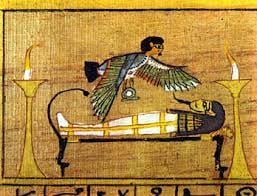
The Egyptians envisioned the afterlife as a continuation of one’s earthly life; death was not a final state, but a transitional stage in the cycle of life from the world of the living to the world of the dead. On the Day of Resurrection, the soul will be returned to a new body and people will stand before God for judgment.
12. Confucius:
Confucius was not concerned with the afterlife. Death ends. It said: Do not use life to give life to death. Do not use death to bring death to life.
13. Taoism:
Taoism Places great value on life. It does not focus on life after death, but on health and longevity by living a simple life and having inner peace.
14. Shinto:
Shinto meaning ‘way of the gods’. Shinto’s key concept is purity, harmony, family respect, and subordination of the individual. It is part of the Japanese character whether the individual claims a religious affiliation or not. Death is the end.
15. Buddhism:
Biddhists believe in a cycle of death and rebirth called samsara. Through karma and eventual enlightenment, they hope to escape samsara and achieve nirvana, an end to suffering.
16. Jews:
The afterlife is known as Olam ha-ba the “world to come”, עולם הבא in Hebrew, and related to concepts of Gan Eden. Among FIVE stages of life after death. One strand of Jewish thought sees heaven as a transitory place where souls reside after death till Messiah comes for their REINCARNATION. (It is not like Hindu rebirth but a very selective rebirth for chosen ones).
17. Christians:
Lives after death are based on the resurrection of Jesus Christ. 9 days after death, it takes 40 days journey to Heaven where God will breathe life back into the dead, restoring them to earthly existence. And God will bring all the dead back to life, not just the righteous. But after being JUDGED on the day of JUDGMENT.
18. Islam:
Goes to Akhirah after DEATH at Allah’s will and stay in their graves until Yawm al-din, the Day of Judgment. Muslims believe that they are on this earth for a “relatively short time” and during this time they are “preparing” themselves for eternal life after death. (BBC)
a. According to the religious text of Islam, male martyrs will receive 72 virgin maidens in paradise as a reward.
b. Narcissism: scientists believe it infuses 8 types of psychic disorders but Allah never said so.
c. The Quran says: “Nor can a soul die except by Allah’s will… The term being fixed as by writing.” : Quran 3:145
d. Alcohol & Islam:
At the Battle of Uhud (Saturday, 23 March 625 AD), Jābir ibn Abd Allah (جابِر بن عَبْد الله) and ’Anas ibn Mālik (أَنَس بن مالِك) believe solder did have “alcohol”. After this battle, it was “prohibited” but it would be available in plenty after death for martyrs.
I believe ‘non-Muslims of the subcontinent’ cannot live as per their scriptures alone because of the various INVASION that has taken place over the centuries and each one has pushed our forefathers to new “escape routes “to survive and preserve identity.
Invader’s Invasion purposes:
The religion of Genghis Khan was ‘ Tengri’, but he was religiously tolerant and interested in learning philosophical and moral lessons from other religions. He consulted Buddhist monks (including the Zen monk Haiyun), Muslims, Christian missionaries, and the Taoist monk Qiu Chuji. Some say he refused to invade India as he was in a hurry to return to china but our history says Alauddin sent an army commanded by his brother Ulugh Khan and general Zafar Khan, and this army comprehensively defeated the Mongols around 1296. Some historians believe Genghis Khan died 70 years before the establishment of the Khilji dynasty in Delhi.
Thus I will not try to reflect any “Tengrist” influence on Hinduism or Sanatani philosophy.

My assumption is before 711 AD all invaders had undertaken expeditions or military invasions for extending new kingdom, more wealth, etc.
711 AD onwards all invasion was for the DESTRUCTION of our “civilization” in addition to other reasons. I think early kings did not understand this and fought as they fought earlier invaders. By the time some of our Sheers, guardians of Dharma, and rulers started realizing the destructive attitude, another destructive force got in as Businessmen and mesmerized us with their brand new deceptions unknown to Indians. As of now their trained and programmed “Indians” refuses to recognize Church’s all-around deceptions.
Therefore, I feel we cannot even imagine how far “The Koran keeping” (on Kafir’s idol) or kafir beheading ones might have thought about afterlife “entitlements”. Is there any other civilization on the earth that ever had or has such lucrative rewards after death?

 subhasmitra.co.in
You must be logged in to post a comment.