
Subhas Mitra : 09 Sep 2022
Making a satire or delightful narration of my real life experiences with tea is not “my cup of tea” nor am I trying to reflect 9/11 as “storm in a teacup” by dating this write up on Sep, 09 2022.
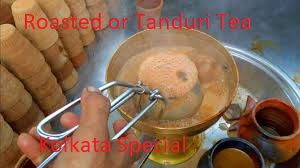
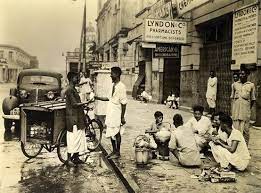
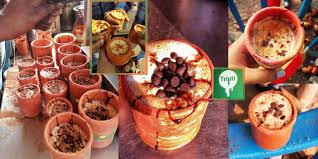
I was born in a farmer family in a village where we never had tea. While in school I once went to nearest town, Bagerhat , with my father and he ordered a cup of tea for me too. I could take only ONE chip as that burnt my “tongue” and could not get the test of my meals for next couple days. In 1964 I came to Kolkata of my own and saw for the first time hawkers selling tea in clay cups at almost every street corner, around cinema halls, parks etc. by mobile tea sellers called ‘chai Walla’ besides usual tea stalls. But I did not forget my FIRST experience.
Within months I joined Indian Navy and was sent to Mumbai/Pune for training. Here tea became part of routine with 5.30 AM Morning tea, 6.30 AM with breakfast, tea breaker at 11 AM and 4 PM. At dinner tea, coffee or coco used to be served. I never heard the name of coffee and coco before joining Navy. SO I was crazy for having it for the first time but experience was disgusting & discouraging but had to maintain table manner.
No one ever told us that numerous studies have shown that a variety of teas may boost your immune system, fight off inflammation, and even ward off cancer and heart disease. While some brews provide more health advantages than others, there’s plenty of evidence that regularly drinking tea can have a lasting impact on your wellness.
In 1983 I joined a France MNC and was posted in Jeddah, Saudi Arabia, where again for the first time tested “Kahwa”, a brew that helps combat problems related to insomnia and anxiety.
Tea drinking hub of India:
Kolkata, known as the ‘tea port of India’, is also the country’s chai-drinking hub. As the capital of British India between 1773 and 1911, Calcutta was the gateway to Chinese tea imports. Then in the 1880s, tea seeds from China were planted in the Botanical Gardens here to test their viability in the subcontinent.
Tea is available almost every city or town in India but Kolkata is called a hub because the Company (EIC) used to distribute tea “ free of cost” to public for creating future consumer/market . By 1980s the city became known for at least 8 types of tea preparations. They are still there unlike other cities.
How I landed in a Tea Garden:
1979 I left Navy and returned Kolkata with appointment letters in hand. One day, almost accidentally I met one of my teachers, Maj. Gen. (Dr.) N C Dutta from AFMC (Armed Forces Medical Collage), Pune. He wanted me to establish a Day Care Center with x-Ray and Pathology lab in a Doors Tea garden by a British Tea company. Pay and perks were so attractive that I could not refuse.
It is at this junction I wanted to know more about tea.
Introduction of Indian tea:
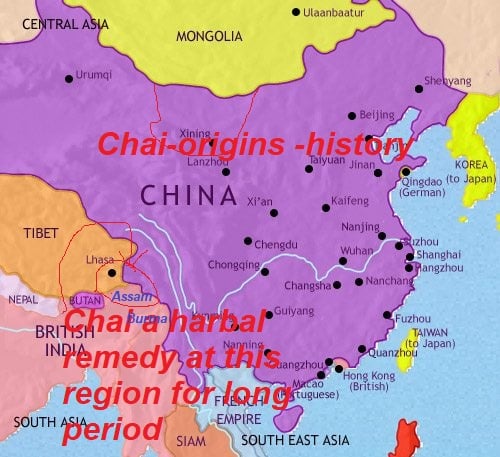
We all were given to understand that British brought tea in India from china but the fact is different from the narratives. Tea is a common plant grows at India, China, and Myanmar and Tibet confluence.
Original name in North East India – চাহ (chah), Hindi –चाय / च, Mandarin – 拆(chai), English took from Hokkien Chinese – tê, (Tea).
Legend: Tea was discovered by:
1. Chinese emperor and herbalist, Shennong, in 2737 BCE. One day a servant began boiling water for him to drink, and a dead leaf from the wild bush fell into the water. It turned a brownish color, but it was unnoticed and presented to the emperor, who liked it.
2. Emperor Jing of Han (d. 141 BCE) in Xi’an announced that tea from the “genus Camellia” was drunk by Han Dynasty emperors.
3. Tea then became a popular drink in the Tang (618–907)
4. Song (960–1279) Dynasties.[2]
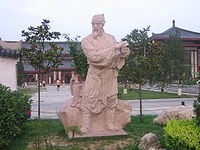
5. King Lu Yu in Xi’an
6. And also infusion of some kind of leaf was used as early as the Zhou Dynasty (1046–256 BCE).
History of Tea plantation in India:
It is all about British but they entered Assam only in 1820s during 40th Ahom king Jogeswar Singha was on throne (1821–1822).
Now please note the dates/times of tea evolution in India.
1. “Camellia sinensis” originated in southeast Asia, confluence of the lands of northeast India, north Burma, southwest China and Tibet.
2. In 1662 Johan Albrecht de Mandelslo, a German adventurer came to India and recorded tea as the semi medicinal brew in regular use.
3. In 1689 John Ovington (1653–1731), an English priest , hired by EIC records that tea was taken by the banias / wealthy traders in Surat (then the richest city in the world) with or without sugar.
4. in 1780. Colonel Robert Kyd (1746 – 1793) founded the botanical garden at Calcutta in 1787. He Claims to have experimented with tea cultivation in Assam by natives and tried to plant it in Botanical Garden, Kolkata.
5. Robert Bruce, a Scottish & ex-Major in the Bengal Artillery who first came to Assam in 1822. In 1823, he visited “Rangpur” (now in Bangladesh) which was the capital of the Ahom Kingdom.
{Please note these dates. British was not even present in Assam when tea was an agro product there}

Here is information I could gather:
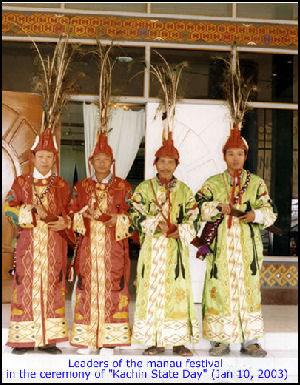
Jingpo people or Singpho people:
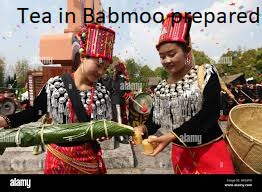
1. The Singpho are a tribe who inhabit parts of India, Tibet, China and Myanmar from their Capital at present days ARUNACHAL PRADESH and part of Assam. (I’ve marked their border on the attached map during rule of King Ningroola.( Appx 12th to 14th century). চাহ (chah ) Tea was their remedial herbs and they prepared it in Bamboo containers.
2. The Ahom dynasty (1228–1826) ruled the Ahom kingdom for 598 years. The dynasty was established by Sukaphaa, a Shan prince of Mong Mao who came to Assam after crossing the Patkai Mountains. They too showed interest in the herb.
3. Tea /Chai is Chinese as much (Mahabharata) Bhim’s son Ghatotkoch is Chinese because the city HIDAMBAPUR became DIMAPUR on his mother’s name, was ruled by The Dimasha tribe ( to whom Nehru pushed to Christianity).
KALITA Raja Maniram Dewan was FIRST tea Garden owner of India:
4. When entire region was annexed by the British East India Company following the Treaty of Yandabo in 1826? Robert Bruce came to know about “tea” from Maniram Dewan, who acquired knowledge from Singpho people.
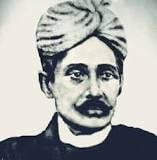
5. Maniram Dutta Baruah, popularly known as Maniram Dewan was an Assamese nobleman in British India. He was the 10th descendant of Gauraddhaj Singh of Kannauj, UP. He worked in Royal Assam Court of law, Known at Upper Assam as “Kalita Raja” (king of the Kalita caste).
6. He was the First Person to establish tea gardens in Assam, India.
7. During the Burmese invasions of Assam (1817-1826), Maniram’s family sought asylum in Bengal, which was under the control of the British East India. Maniram was KILLED (exactly the way Warren Hastings killed Naba Kuman De in false conspiracy) and Bruce was projected as founder of tea Estates, cultivation, and plantation. Bruce did take it to North Bengal, Darjeeling, Sylhet (now in Bangladesh) and Nilgiri, in the Southern India.
What I learnt from the story:
Our ancestors knew the “value” of the plant but British understood the “Price /Cost” of the plant. EIC not only cultivated but created market / consumers among us Indians by feeding FREE chai in Govt. offices/institutes and near Kolkata Rly station, busy city centers etc. They took it to 52 countries .When British left almost none of the local Ahom or Bengalis became owners but all outsiders.
During Communists era till today all Bong garden owners has become semi beggar due to administrative atrocities on them through workers.
Commerce and Economy of Tea in India:
No matter how much we talk of indigenous tea history, the commercial production, marketing, employment generation and economy from tea is purely a British hard work. Early 1788 to 1824 they faced / overcame wild animal attack, snake bite, malaria and almost un- inhabitable weather condition, far away from localities. There was no air –travelling. It looks 6 months ship journey to reach Kolkata (there was no Suez canals) and no one was allowed to bring family.
A note:
I have not met any of those Englishmen but met TWO of their descendants (Anglo-Indians) at DOORS where there was (in 1979-80) a locality near CHALSA market where those Englishmen’s Indian “tribal sex partners-garden workers) used to be kept as they could not be taken to official accommodation of the white managers. When India became independent children of those (mostly unwed) darks women’s white children were not allowed in UK. This Two Men told me that their father was British military men.
Tea Production:
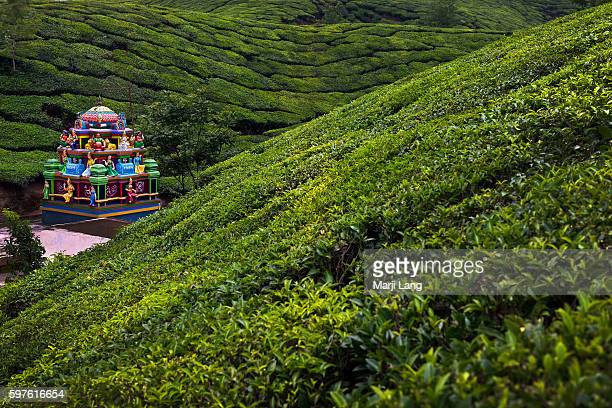
The Assam valley and Cachar are the two tea producing regions in Assam (52 %). In West Bengal, Doors, Terai and Darjeeling are the three major tea producer regions (21%). The southern part of India produces about 17% of the country’s total production.
There are over 3000 varieties of tea, each with its own specific characteristics. In India there are at least six different types of tea: white, yellow, green, oolong (or wulong), black or china and post-fermented tea.
Spiritual angle of the brew:
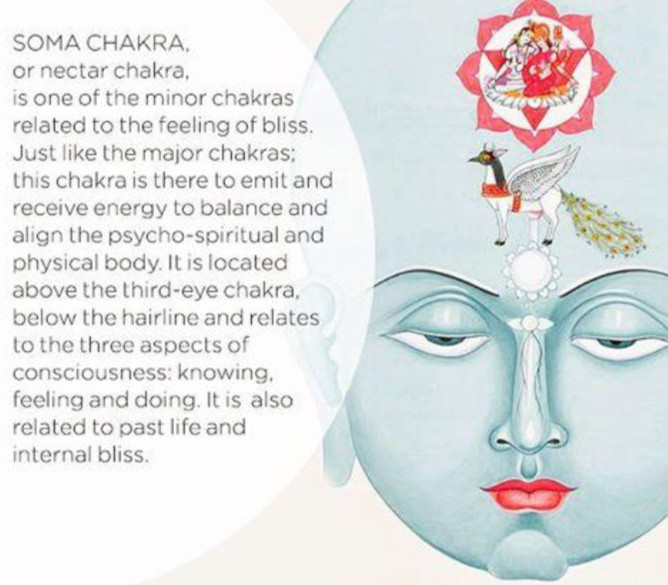
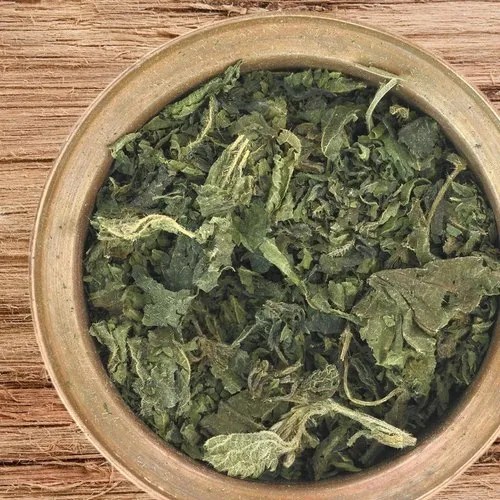

Beyond and besides these commercial classifications there is a spiritual angle of this brew. “Sri Vidya” practitioners of Tantra Kundalini Kriya Yoga School believe ‘SOMCHAKRA’ (near Medulla oblongata or ‘God’s Mouth’ in Biblical term) has a ‘secretion’ called SOMRAS which elevates Yogi’s consciousness and free from sorrow. (Sanskrit SOM also mean Moon/ lunar). In Ancient days they knew external stimulation to the ‘Somchakra’ by fermented fruit juice, light Alcoholic comparable to Barbarian brew or ‘beer’ named on Barbara, a Byzantine goddess (now known as St. Barbara Byzantine for Catholic).
This word Somras is used for of TWO types external stimulants – one Alcoholic and another is Cha,Chea or choi. This choi is nothing but ‘tea’ of highest altitude of Himalaya in Ladakh to Tibet. It is available in stores as Ayurvedic herb. Next lower height product is FALVORED tea like Darjeeling and last semi- plain product is CTC.
World’s most costly tea is: Valued around a whopping $1.2 million per kg, Da-Hong Pao tea from China.
India’s heist tea of 2021 is ‘Manohari Gold’ from Manohari tea estate was sold at ₹ 99,999 per kg.( wiki)
Chai is the National Drink of India
Germination and planting:
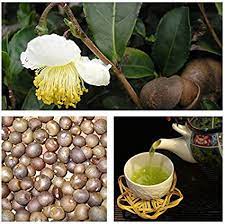
Prior to germinating, ripe reddish-ripe brown tea seeds (fruit) are collected and its pale –brown seeds are separated.
Tea is tree but for plucking leaves they are kept like bush and not allowed to become a tree until felt necessary for production of seed.

Job scope:
There are various training in tea industry from ONE month-certificate, 3 months diploma to MSc (Agro-tea husbandry)
Most advance and largest : Tea Research Association popularly known as TRA Tocklai ,Assam looks after the research and development needs of the Indian tea industry.
Tea Board and Auction:
It is part of a global business, 3 British companies in Kolkata used to manage Auction since 1861 with branch in Jorhat ,Assam. After independence TEA BOARD was made here in 1953 and there are two Zonal offices-one each in North Eastern Region at Jorhat and in Coonoor in Tamil Nadu.
Auction Centers:
Among the 14 auction centers of the world nine are situated in India. These are Amritsar, Calcutta, Cochin, Coimbatore, Coonoor (two centers), Guwahati, Jalpaiguri and Siliguri.
Conclusion:
In my opinion there cannot be any doubt that the British popularized tea as a brew worldwide and developed its mass production, trade, and commercial infrastructure in India. But saying tea was introduced in India by the British is only that much true as much as much saying Baktiyar Khilji developed Bengal as a separate province and its language, calling Bhim’s son Ghototkach a Christian from Nagaland, Hindus learned to wear cloth from Arab and science from Church schools in English.
I think ‘food and treasure’ hunters had to do what they did.
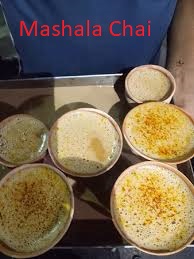
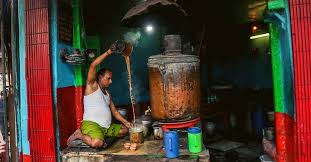
Some special tea served images:

 subhasmitra.co.in
You must be logged in to post a comment.