
Subhas Mitra: 16 Jun 2023
Ever since I started taking an interest in history, I concluded, “Hinduism survives because of Brahmin, Sanskrit and Varnashram Dharma” (BSV- effects).
As a student, we learned that SAKAS &HUNAS came and were absorbed into Indic civilisation, while the Greeks came and went back. However, Muslims made a permanent entry in 711 AD, followed by Christians (Dutch, Portuguese, and British). Hinduism declined because of the BSV (caste system), but it is 180 degrees opposite in my findings.
There was no caste in Mesopotamia, Babylon, Egypt, Anatolia (Turkey) or Spain / Morocco – where is their civilisation today?
Some Dalit converts to Christians with Hindu names in the USA (Snake in the Ganga) are trying to make fresh wounds on dried scars of colonisers’ concocted Hindu past. However, a search along my line of thinking reveals a different story.
Multan:
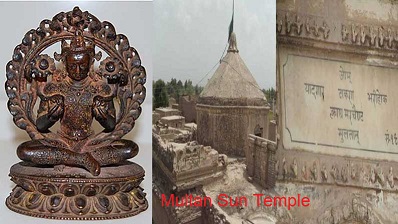
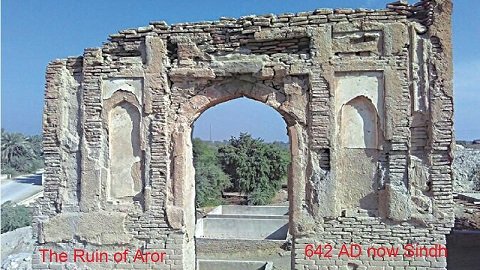
Multan was not only the Capital of Raja Hiranyakashipu and Prahlad but also a major Pilgrimage centre, mainly because it was a confluence of pre-Christian, pre-Islamic Arab & Mesopotamian civilisations with the Saraswati-Sindhu or Indus Valley civilisation. Multan is “Mulasthan”, as the capital of the ancient Trigarta Kingdom in the Mahabharat.
Varnashrama Dharma held us together by giving a sense of SWADHARMA. For argument’s sake, let us not discuss Dronacharya, Parashurama or Karna for their deviation from Swadharma and discover what happened in MULTAN.
Multan was also known as SHAMBAPURAM, the capital founded by King Samba. He was the son of Sri Krishna and his second consort, Jambavati. After being cursed into a leper, Samba had urged his father, Sri Krishna, to restore his youth, who noted the Sun God (Surya) alone had such abilities.
A mighty Sun Temple was built at the bank of the CHANDRABHAGA (some call it RAVI) river. Both the SAMBA & VABISWA Puranas are believed to have been composed here.
Pre-Islamic Arabs were Assyrians and Shivaism influenced. Zoroastrians were FIRE worshipers and closer to Hindu Fire worshipers too. Some scholars believe parts of the VABISYA Puran might have been written in the Persian script and the Padma Puran in Bengali.
It could be because among the 18 Mahāpurāṇas, there are a few that started as “shruti” (oral composition) and were written later over the period. Scholars believe they were written between the 4th century CE and the 15th century CE. Most controversial are the Bhaviṣya Purāṇa for its future prediction properties and the Padma Puran for its Vaishnav character.
Some parts may even be slightly later—Purāṇas continued to be edited into the early modern era, and that would have created language confusion.
Ref:
- Rocher, Ludo. The Puranas (History of Indian Literature, Vol. 2.3). Otto Harrassowitz, 1986.
- R.C. Hazra – Studies in the Puranic Records on Hindu Rites and Customs
Brahmi and Persian script :
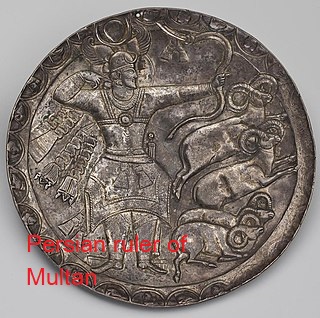
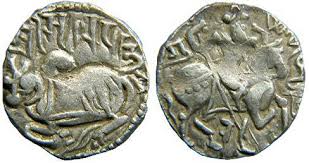
Both Hindu Suryabansi and Buddhist rulers minted their coins in the Brahmi script. Persian script made inroads in the region in those days in literature and record-keeping.
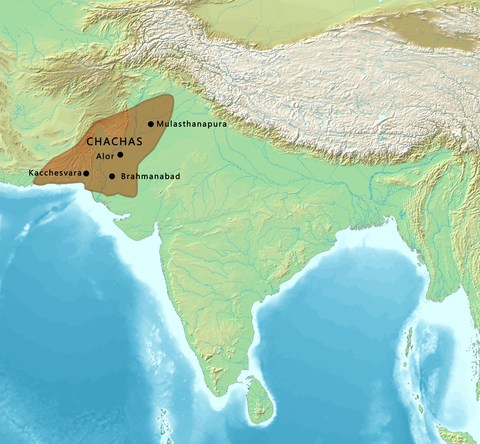
This region has been a ‘confluence’ as well as a ‘ground of tussle for power’ between local rulers and mighty Persian rulers. The history of those conflicts or Battle Wars was recorded in CHACHNAMA, written in Persian and Brahmi script. (It was translated into English by Mirza Kaleech Beg in 1900 under the title, The Chachnama: An Ancient History of Sind. Dr N.A. Baloch also translated and added a period of rule of Sahasi-II (both I and II were Persian Zarathustra turned Buddhists), who ruled Sindh from 626 to 652 CE.
Hindu-Buddhist Jugalbandi :
What started with Emperor Asoka continued in Gandahar(Kandahar) when the capital was TAKSHASHILA. After the destruction of Takshashila, Kabul-Zabul was under Hindus, while many parts extending to MEKRAN, the coastal region of Baluchistan, fell to Buddhists, but CHACH ( Sindh) was under Zoroastrians and later to Buddhists by one source and/or SURYABANSI Hindus as per CHACHNAMA (Chach Nama is also known as the Fateh nama Sindh, and as Tareekh al-Hind wa a’s-Sind).
How Kshatriya Suryabansi became Brahmin:
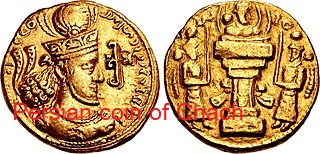
Peroz -I was the Sasanian King of Iran from 459 to 484. A son of Yazdegerd II, he disputed the rule of his elder brother and incumbent King Hormizd III, eventually seizing the throne after a two-year struggle. His reign was marked by war and famine.
“Debal” (named after Debal Rishi) was an ancient port near modern Karachi, Pakistan. It is adjacent to Manora Island and was administered by Mansura and later Thatta. It was under the Suryabansi Hindu kings, the Rai Dynasty. There is another version where they are projected as Buddhists.
Rani Suhanadi (7th-century), also known as Sohman Devi, was a queen consort. She was married first to Rai Sahasi II of the Rai dynasty and secondly to Chach of Aror, Maharaja of Sindh.
She is known for her role in the succession of her first husband.
Here too, I find TWO versions of the sequence.
ONE:
Her First husband had a Brahmin general as Army chief, and she fell for his charm and manliness. Rai Sahasi II fell sick under the pressure of age and appointed the Army chief as Chah of Aror (one of his kingdoms) under his wife’s insistence. After Sahasi’s death, she married the Brahmin Chach of Aror.
TWO:
One of the sons of SAHASI II was crowned as Chach of Aror. Sasanian King FEROZ-I was a weak and inefficient king. Chach of Aror attacked him. Iranian forces joined, and in the fierce war, Chach of Aror was killed, but the Brahmin chief of the Army did not give up and ultimately won and chased the KORASANIS out of Chach (MULTAN included).
The “young wife” of the Chach of Aror was married to the Army chief, and he was declared the next King. The dynasty thus became Brahmin.
Kashmir connection:
Unlike Kashmir Islamizer Butshikan, his descendant Zain-ul-Abidin (1423–74) valued and operated meritocracy. Brahmins and Buddhist monks thus became his closest advisors.
There cannot be an ‘Effect’ without a ‘Cause’. Raja Dahirsen’s forefather gave a tough fight to Muslim invaders for over 300 years before his fall, but Kashmiri Brahmins were ‘Pundit’ and pious SWADHARMI & not warriors. Historians say Buddhists, on the other hand, extended their AHIMSA, hospitality and cooperation to Muslim invaders and accompanied them to Kashmir and Afghanistan.
Conclusion:
Takshashila was FIRST time destroyed by the Huns, and was reconstructed by Mihirkula after about 200 years.
Brahmins of Chanakya School of thoughts moved towards the south (Sindh). Kshatriya Tej diluted as rulers became Buddhists. They might have favoured Buddhist Monks against Brahmins. Brahmins might have softened their stands and come close to Buddhism for royal patronage.
Slowly, they lost their Brahma Tej (fire at the tip of their tough, the power of curse and blessing).
Muslim invaders have found Brahmins and Buddhist monks on the same page and favoured them.
Even Christian rulers used them for things they should have avoided for the greater benefit of the Vedic way of living.
Some Brahmins played a major role in weakening Hinduism in Kashmir, Kerala and Bengal (as Bhadralok).
Ref:
- ʾAḥmad ibn Yaḥyā ibn Jābir al-Balādhurī was a 9th-century Muslim historian.
- Abu Rayhan Muhammad ibn Ahmad al-Biruni, known as al-Biruni, was a Khwarazmian Iranian scholar and polymath during the Islamic Golden Age.
- Xuanzang, also known by his Sanskrit Dharma name Mōkṣadeva, was a 7th-century Chinese Buddhist monk in 629–64 AD.
- Cummins, Joan Marie (2001). Dual darśana: Re-addressing the Sūrya icon (Thesis).
- Bronkhorst, Johannes (2014–2015). “The Magas”. Brahmavidyā: The Adyar Library Bulletin
- wikiwand (A.I. based)
- Muhammad Ali Shaikh wrote in The Dawn, February 11, 2022
 subhasmitra.co.in
You must be logged in to post a comment.