
Subhas Mitra : 30 March 2024
Part- 6 (to be continued)
God of Genesis created LIGHT on day one but The Sun on day FOUR, out of nothing.
Vedas tell NOTHING can come out of NOTHING.
A seeker is to seek to know “that something” (Auto Creating Ability) from “which” (Creator) the creation is created. The journey should start from within ONESELF.
Why?
The creator and the ability are the same. Some gave ONE name, and we gave SEVERAL names. The supreme being ( Paramatma) is:
BHAGAVAN:
उत्पत्तिं प्रलयं चैव भूतानामागतिं गतिम् |
वत्तिं विद्यामविद्यां च स वाच्यो भगवानिति ||
He who understands the creation and dissolution, the appearance and disappearance of beings, the wisdom and ignorance, should be called Bhagavān.
— (Vishnu Purana, VI.5.78)
ISHVAR:
क्लेशकर्मविपाकाशयैरपरामृष्टः पुरुषविशेष ईश्वरः – Yoga Sutra, Samadhi Pada, Sutra 1.24
God is a special Being who is free from afflictions, actions, fruits of actions and impressions.
Some believe No creation of God can equate God but Hinduism says creation/creativities of God is also God.
Like the tiniest Magnet too has the properties of the biggest magnet (magnitude or potential may vary).
In Chapter 10 of Bhagwat Gita, Sri Krishna wants us to seek him in his creation with special emphasis on certain objects/properties often personified or symbolized and given a suitable name and sign.
Shloka – 27
उच्चै:श्रवसमश्वानां विद्धि माममृतोद्भवम् |
ऐरावतं गजेन्द्राणां नराणां च नराधिपम् || 27||
Translation:
Amongst horses know Me to be Ucchaihshrava, begotten from the churning of the ocean of nectar. I am Airavata amongst all lordly elephants and the king amongst humans.
Narration:
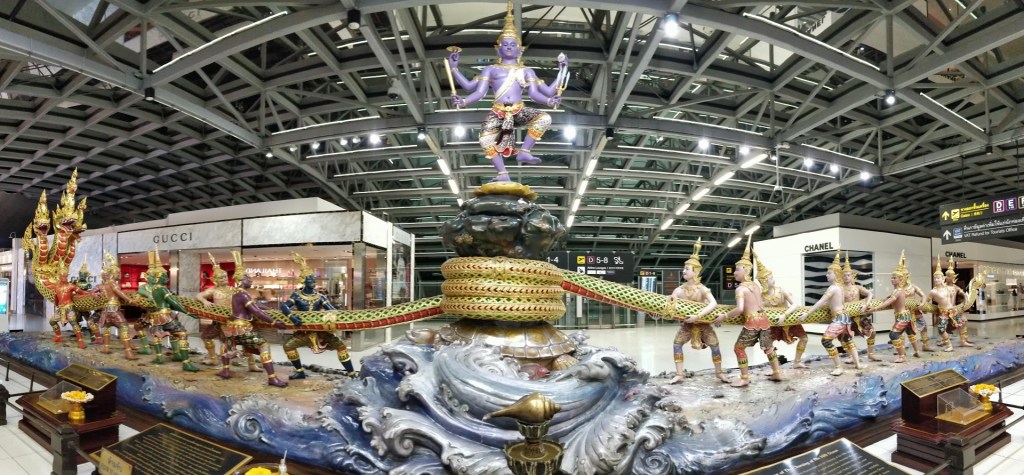
This shola takes us to SAMUDRAMANTHAN (churning of the cosmic ocean) appears in Vishnu Purana. We know the story of churning by both Devata and Ashura for AMRITA (immortality).
Samudra Manthan :
Note:
The weakening (misinterpretation) of Hinduism has been a symbol of modernization in INVEDER’s India that started with the destruction of TAKSHASHILA University by Huns during a major reform era of Buddhism & Jainism. When the university was re- re-established it went into the hands of Godless Buddhists who questioned the authority of Vedas. Midst of a socio-political and philosophical turmoil, Hindu Wisdom came under intellectual challenges, pressure and confrontations. Perhaps SHRUTI & SMRITI were declining or losing hold and new means (composition/writing) evolved.
The Vedic सूक्त / Suktas needed simpler explanations as stories to carry it to commoners. It was The Puranas (meaning the old) that might have started recording and narrating Vedic Principles and Observations in a simple, lucid and attractive manner.
While narrating various celestial power points (Vedic gods/goddesses and Ashuras) the Puranas might have personified them. The Puranas are known for the intricate layers of symbolism depicted within their stories/lore. The Puranic literature is encyclopedic, and it includes diverse topics such as cosmogony, cosmology, genealogies of gods, goddesses, kings, heroes, sages, and demigods, folk tales, pilgrimages, temples, medicine, astronomy, grammar, mineralogy, humour, love stories, as well as theology and philosophy.
Abrahamic invaders took advantage of those stories and compared their Myth and Dogmas with our “stories” perhaps to paint us their color.
It is our good fortune that the British caught some Hindu employees, sent them to Banaras to learn Sanskrit and then got our scriptures translated into English. Some Persian scholars Hindu, who learnt English later, joined the fray.
It could be because the Vedic Sanskrit & its grammar is different from the Sanskrit, invaders popularized, thus they could not do mischief with the Vedas the way they did with later Sanskrit literature and scriptures.
However, it is very encouraging to note that modern Hindu intellectuals have taken the task at hand by forming the India Knowledge System at IITs.
Here are the narrations of shloka where Sri Krishna wants us to see Him.
Ucchaihshrava – उच्चैःश्रवा: is a seven-headed flying white horse, created during the churning of the milk ocean. It is considered the best of horses, the prototype and the king of the horses. Both Indra and Ashur King Bali owned it. Indologists and Hindu Chronologists believe Satya Yuga is millions of years before Christ.
Horse
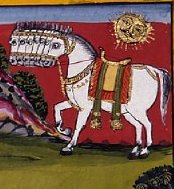
** Horse in Satya Yuga: ordinary people like me are told by a class of historians that HORSE was foreign in India because they found foreign horses while working on Mohenjo Daro – Harappa (–existed between 2600 and 1900 BCE). The site was discovered in the 1920s.
Airavata ऐरावत is the “king of elephants” and also serves as the main vehicle for the Indra. It is also called ‘abra-Matanga’, meaning “elephant of the clouds”; ‘Naga-malla’, meaning “the fighting elephant”; and ‘Arkasodara’, meaning “brother of the sun”.
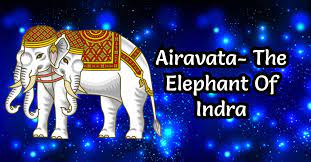
‘Abhramu’ is the elephant wife of Airavata.
Airavata also has the power to bring rain and storms.
He is worshipped by the male-to-female transgender in India.
NITY Aayog proposed an acronym AIRAWAT, i.e. the “AI Research, Analytics and Knowledge Assimilation platform.
Shloka: 28
आयुधानामहं वज्रं धेनूनामस्मि कामधुक् |प्रजनश्चास्मि कन्दर्प: सर्पाणामस्मि वासुकि: || 28||
Translation:
I am the Vajra (thunderbolt) amongst weapons and Kamadhenu amongst the cows. I am Kaamdev, the god of love, amongst all causes for procreation and amongst serpents, I am Vasuki.
Narration:
VAJRA: वज्र :
Indra was once driven out of his celestial kingdom by a demon named Vritrasura, who had a boon whereby he could not be killed by any weapon known till then.
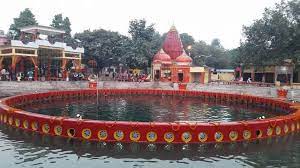
In desperation, Indra approached Lord Shiv for help, who took him to Lord Vishnu. Vishnu revealed to Indra about the thunderbolt वज्र, made from the bones of the sage Dadhichi. Indra then beseeched Dadhichi. Dadhichi accepted the request but desired to first go on a pilgrimage to all the holy rivers. Indra then brought together all the waters of the holy rivers to Naimisharanya KUND (the centre of learning of 88,000 sages) thereby allowing the sage to have his wish fulfilled without further loss of time. Dadhichi then gave up his body and the thunderbolt made from his bones was then used to defeat the demon Vritrasura.
Dadhichi Muni / Sage: In the Bhagavata Purana, Dadhichi is described as the son of the sage Atharvan and his wife, Chitti. Atharvan is the author of Atharvaveda. Chitti was the daughter of the sage Kardama. The names of Dadhichi’s wife and son were Suvarcas and Pippalada, respectively.
Dadhichi

Naimisharanya: also known as Nimsar or Nimkhar and is located on the left bank of the river Gomati, 45 miles north of Lucknow in Uttar Pradesh. It is mentioned in both Ramayana and Mahabharata.
Naimisharanya Kund:
Archaeological Vajra: Mining businessman Syed Shammer Hussain from Bangalore, India accidentally found a Ten Thousand-year-old TRISHUL along with a 3000-year-old Vajra from his mining site in the Philippines in 2015. He has registered with ASI and exhibited his find to international enthusiasts and refused to part with it.
Hussai Image

KAMDHENU: कामधेनु :
Kamadhenu, also known as Surabhi, is a divine bovine goddess described in Vedic scriptures as the mother of all cows / bovine family. She is a miraculous “cow of plenty” who provides her owner whatever he desires and is often portrayed as the mother of other cattle as well as the eleven Rudras. There are other descriptions as well.
The Mahabharata (Adi Parva) records her rise from Manthan and Braham takes and gives to the Saptarishi.
The Cow

In the Ramayana, Surabhi is the daughter of sage Kashyapa and his wife Krodhavasha, the daughter of Daksha.
- In Vishnu Purana and Bhagavata Purana, Surabhi is described as the daughter of Daksha and the wife of Kashyapa, as well as the mother of cows and buffaloes.
- A legend narrates that the sacred cow Kamadhenu resided with sage Jamadagni from where Kartavirya Arjuna stole her and ended up in a war.
- By holding her tail a departed soul can cross BAITARANI (the cosmic sea between IHALOK (this world) and PARLOK (the other world).
- Rishi Vastita was gifted one by Devraj Indra. He also used her to defeat the army of Vishwamitra.
Vasuki:
As per Vishnu Puran, Vasuki – वासुकि is the king of the nagas having a gem called Nagamani on his head. Shesha Nag, the bed on which Vishnu rests, is his elder brother, and Manasa is his sister.
He represents selfless devotion being around the neck of Shiva. It also symbolizes the awakened Kundalini power of the Muladhara chakra.
We have seen various “godly properties” in names appear in Sl-27 & 28 but KAMDEV needs special mention.
KAMDEV-कामदेव :
Kamdev is the god of love and procreation or sensual union or sex. Why it is so special? It is special because every creative process is pure and divine, not merely a basic instinct and object of physical pleasure of a living being.
Have we ever thought if there was no pleasure how many creatures would have indulged in sex to procure offspring? This “Act” is associated with attraction, choice, possessiveness desire, expectation, and cooperation of the SOMCHAKRA (serotonin etc.), anatomical and physiological abilities and all reproductive organs and its “secretions” including catecholamine.
Kama ( काम ), is also known as the Hindu god of erotic love, desire, pleasure and beauty etc.
Kamdev Yantra, not comparable to Cupid:

Animals do not have a marriage system but they select their mate, mostly by female depending on her liking the type of offspring they like to have.
We humans have evolved a process of selectively designed breeding by adopting means. Perhaps the Hindu marriage system has been a process of obtaining a designed society through the natural selection of mates and mating event management (Samskaras).
Marriage is one of the 16 Samskaras (Karma or sacraments in Hinduism). It is neither a license to possess a woman for service and sex nor a contract for child production.
The next step is:
Garbhadhana (गर्भाधान), literally means attaining the wealth of the womb It is a ceremony performed before conception and impregnation. Scholars trace this rite to Vedic hymns of the Rigveda, where repeated prayers for progeny and prosperity are solemnized.
- प्रजां च धत्तं द्रविणं च धत्तम् : bestow upon us progeny and affluence . — Rig Veda 8.35.10 – 8.35.12, Translated by Ralph Griffith[26]
The Vedic texts have many passages, where the hymn solemnizes the desire to have a child, without specifying the gender of the child. For example, the Rigveda in section 10.184 states,[24]
- विष्णुर्योनिं कल्पयतु त्वष्टा रूपाणि पिंशतु । आ सिञ्चतु प्रजापतिर्धाता गर्भं दधातु ते ॥१॥
गर्भं धेहि सिनीवालि गर्भं धेहि सरस्वति । गर्भं ते अश्विनौ देवावा धत्तां पुष्करस्रजा ॥२॥
हिरण्ययी अरणी यं निर्मन्थतो अश्विना । तं ते गर्भं हवामहे दशमे मासि सूतवे ॥३॥
May Vishnu construct the womb, may Twashtri fabricate the member, may Prajapati sprinkle the seed, may Dhatri cherish thy embryo;
Sustain the embryo Sinivali, sustain the embryo Saraswati, may the divine Aswins, garlanded with lotuses, sustain thy embryo;
We invoke thy embryo which the Aswins have churned with the golden pieces of Arani (firewood), that thou mayest bring it forth in the tenth month.
— Rig Veda 10.184.1 – 10.184.3, Translated by HH Wilson.
Copulation is not a sin but संभोग,a pious act:
Original sin is the Christian doctrine which says that because of the sin of Adam and Eve, original innocence is lost and all subsequent human beings are born into a state of sinfulness. The doctrine states that human beings do not commit this sin but rather contract it from the Fall of Adam and Eve (CCC: 404).
Somewhere काम / sex are sin, elsewhere it is pleasure obtainable even after death in heaven.
For us it is an act of God and hence the personification and symbolization:
Scholars believe chastity was practised in Buddhism, Papal discipline and now some Hindu schools of thought originated from Buddhist / Jain. None of our gods are without goddesses nor was any of our sages unmarried.
Brahmacharya ब्रह्मचर्य is not abstaining from sex but a concept of sexual discipline that literally means “conduct consistent with Brahman” (with sincerity and fidelity). It does mean abstinence for unmarried students.
Story of Kamdev :
Kamdev appears in the Shiva Purana, the Kalika Purana, the Brahma Vaivarta Purana, and the Matsya Purana.
He is Manasputra of Brahma and his wife is Rati रति daughter of Prajapati Daksha, has many names:
Other names prominently used about Kamadeva are:
Kama (काम) – desire; longing.
Manmatha (मन्मथ) – one who agitates mind
Madana (मदन) – one who intoxicates with love
Mara (मार) – he who wounds
Ananga (अनंग) – he who is without a body
Kushumeshara (कुसुमशर) he whose arrows are flowers
Pradyumna (प्रद्युम्न) – he who conquers all. It is also the name of Kama’s reincarnation
Kandarpa (कन्दर्प) or Darpaka (दर्पक) – the inflamer. Brahma gave him this name
Manasija (मनसिज) , Manoja (मनोज) and Bhavaja (भवज) – he who is born of mind
Ratikanta (रतिकांत) or Ratipati (रतिपति)- husband of Rati
Abhirupa (अभिरूप) – the beautiful one. Also a name for both Vishnu and Shiva
Kam ( काम) also means one of the THREE stages through which we can obtain MOKSHA i.e.
Dharma
Artha
Kama
Therefore each of the “properties” of Sri Krishna is also Sri Krishna. Because ॐ पूर्णमदः Divine Consciousness is Non-Dual and Infinite.
 subhasmitra.co.in
You must be logged in to post a comment.