
Subhas Mitra: 12 Sep 2025
Islamization of two Temples and a Hindu kingdom:
ना ढाल ना तल्वार,
कलम क्या कमाल .
According to R C Majumder, the Sen dynasty { Keshava Sena (1225–1230)} was in full command when Bakhtiar Khilji entered Bengal after the ‘secularism’ of Nalanda University. Islamization started in Buddhist-dominated Eastern Bengal, and western Bengal remained intact till the time Rajiv Lochan Rai became Muslim ‘Kala Pahar’ after 156.5 Kalinga King Mukunda Deva allied with Akbar and parted with Raja Rudranarayan (elder brother of Kalapahar) of the Bhurishrestha kingdom of Bengal. (Present-day districts Hooghly, Howrah, Medinipur, Bardhaman, and Birbhum).
Rajiv Lochan, married a daughter of the Gaur (Malda) sultan, became Muslim, but when he convinced his wife, he went to Jagannath Dham, Puri, for a Gharwapasi but was refused. He became Kalapahar, the Hindu convert & Muslim manufacturer. But BHABASHANKARI, his elder brother’s wife ( বৌদি-भाबी), fought furiously against Afghan ( her देवर का सशुराल) forces and earned the RAIBAGHINI title from Akbar (1556 to 1605).
What if Geography refuses to accept History?
TRIBENI, Hooghly district of WB, was Rudranaraya Rai Mukhati’s ( Mukhopadhya) Navy HQ in the 16th century. Portuguese too made their presence as traders, and the British built specific cottages during WWII.
But the name of this place appears in Puranas as MUKTAVENI (open Braid/plait of Ganga Devi) while Prayagraj / Allahabad SANGHAM is known as YUKTAVENI. It is at the confluence of the Kunti, Ganga, and Saraswati rivers and, as usual, a pilgrimage site for Hindus. Finds are mentioned in Pavanaduta. Pavanadūta is an important example of a “duta-kavya” composed by Dhaoyi, a Sanskrit scholar and poet at Lakshman Sen’s court.
It is believed that it was a KUMBH site like Prayagraj, Hardwar, and Nasik before the Islamic invasion. Here too, there are names like SAPTRISHI Ghat, Sapthgram, Kunti Ghat, etc. Besides the ancient Radhamadhav Temple and Anata Basudev Temple, there was a “Vishnu temple” built by the Kalinga King of the 12th century, when this place was the centre of learning / Sanskrit university ( even when Islam entered, united Bengal had 6 universities, but some English-knowing Bongs say Bengalis were “DUD” before the British came) .
The slab or stone bricks of the temple resemble those of the LINGARAJ Temple of Odisha. I could not know what GHUPARAM/ Chura of the Temple looked like. There are no hills/mountains around 100s of Km from this site, which shows all stones were brought from outside. Temple pillars were coupled and reassembled. The architect is also similar.
711 AD onwards, Hindus never gave up their holy places to invaders unchallenged. The tussle here, too, between Temple and Dargah might have been lingering for long.
Joseph David Beglar of ASI – Bengal, photographed the interior in 1872 and found it an unused jungle.
If built around 1298, then who stopped the use of DARGAH/ Mosque and when? Who declared it a DARGAH again after 1872 and went under ASI?
I do not know.
My personal take on the temple known as:
Zafar Khan Ghazi Mosque in Tribeni (WB), built around 1298 CE.
Can Congress be called an Indian National Party?
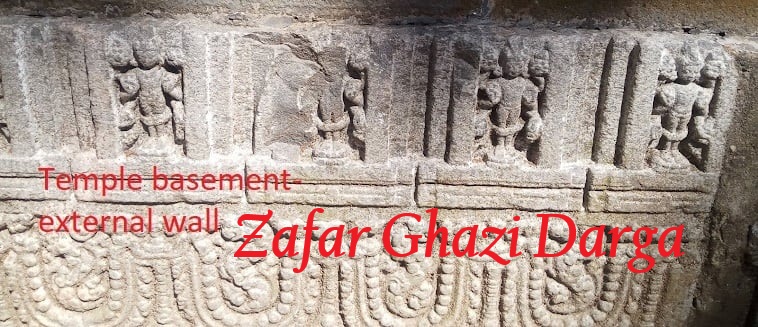
British surveyor James Rennell’s map of Bengal of 1781 spelt Tribeni as “Terbonee”. WIKI gives mostly literary and Muslim devotional versions. I could not get any authentic book to justify my claims, but I tried to collect local information, some of which seems to be myths. Rest you can find below:
1. In 1908, the British published the site in the Bengal Gazette as monuments (image attached), but Congress in 1958 did not mention it as a “Broken Temple” or “disputed site” like Ram Janmabhumi, Kashi, and Mathura. In 2010, Congress again amended the Act when there was a sign of a claim from the Hindu side.
2. In 1810, the British planned to steal the Hindu Temple’s money and issued a circular from Kolkata. In 1840, they promulgated an act from Madras, and Congress renewed the same even in 2010, with further strict amendments to empower states to loot temples.
But when it came to earning from the Taj Mahal, they gave it to the Sunni Waqf board through an Act that the British brought in 1920, and Congress made it a ‘Law’ by 2013.
3. Where there is an earning (Taj Mahal), it belongs to the Waqf Board. Where there is no income, public money funds the maintenance /ASI / GoI. कांग्रेस दा जबाब नहीं .
As per oral tradition this slokas are attributed to Zafar Gazi’s composition:
যৎতক্ত্যং জননী–গণৈর্ষদপি ন স্পৃষ্টং সুহৃদ্বান্ধবৈ–
যস্মিন পান্থ দিগন্ত সন্নিপতিতে তৈ স্মর্য্যতে শ্রীহরি।
স্বাষ্কে নস্য তদীদৃশং বপুরহো সংনীয়তে পৌরুষং
ত্বং তাবৎ করুণাপরায়ণপরা মাতাসু ভাগীরথী॥
The Fact :
This is part of GANGASTOTRAM of Rishi Vyas Dev found also in Śabdakalpadruma (Vol. 2, 1822 edition, p. under entry “Bhāgirathī”).
In Bangla, it is used by
1. Bankimchandra Chattopadhyay, Bangadarshan (1872–74)
2. Radhakanta Deb’s compilation of ślokas also contains it under “Gaṅgā-stotra.”
3. Haraprasad Shastri in Bharati magazine (1890s)
Here is an authentic online search result:
Does a TRUTH need so many versions?
This is an archaeological site (since there is no income like the Taj Mahal, it is not under Waqf). I visited to see with my own eyes.
1. “Zafar Khan Ghazi was General of Alauddin Khalji … killed by Qutlugh Khwaja at Kili (1299).”- wiki
2. Hizabruddin Zafar Khan- Alauddin Khalji, after suppressing Malik Chajju, appointed him Guv of Khera (near Praygraj).
3. According to Banglapedea and inscription to 1298, Tribeni Zafar Khan is a different person.. Ref: JASB (1870) Blochmann “inscription” note and Beglar’s ASI report (1870s). THE INSCRIPTION: “Zafar Khan, the Turk, the ‘lion of lions,’ and the most excellent one of builders of benevolent edifices … by smiting the infidels with sword and spear and lavishing treasures …” makes the site akin to “a sort of museum of older artefacts”. ( I DO NOT FIND ANY SUCH SIGN)
4. J D Beglar found an inscription and wrote in the Asiatic Journal of Bengal – “The temple… must have been of the style of the beautiful and profusely ornamented… scenes from the Ramayana and others.”
5. Blochmann and Money had previously documented remnants of a cluster of dilapidated Hindu temples visible.
6. Joseph David Beglar photographed the interior in 1872, describing it as overgrown with vegetation, in a state of imminent decay. (WHO GAVE THE SITE TO MUSLIMS FOR PRAYER?)
Asian Ethnology:
The site is an Ancient Temple. (All visible deities are present even today). Sir Jadunath Sarkar’s Analysis based on three Arabic inscriptions found at Tribeni shows:
1. Zafar Khan was indeed sent on a mission of conquest to Saptagram (Tribeni) by the ruler of Lakhnauti ( Malda) , Ruknuddin Kaikaus (grandson of Delhi Sultan Ghiyasuddin Balban), during which he attained martyrdom.
2. More than one “Zafar Khan” may have played roles in the foundation of the mosque and madrasa at Tribeni.
Muslim Authors:
1. Md. Mozammel Huq — novelist and public intellectual (late 19th / early 20th c.).: wrote a novel titled Daraf Khan Gazi (FICTIONAL treatment linking to the Ghazi tradition).
2. Mahiuddin Ostagar (of Santipur), a poet: popular histories that treat how Muslim poets remembered the early Ghazi figures.
Coming back to Temple demolishing or Ancient Graveyard:
- Please read the ASI notices that say Zafar Khan Gazi BUILT this MAJHAR/Dargah in 1298.
- The entire Hooghly district demography is Hindu- 82.89%, Muslim – 15.77%. (2011) . At Tirbeni, it could be below 5-7% (appx).
2. This Gazi was General of Allauddin Khalji, who became Guv of Khara in 1291, and Gazi was sent to fight wars in Multan and adjoining areas against Mughal invaders. He was killed by Qutlug Khwaja at the Battle of Kili near Delhi in 1299. When did he come to BUILT this Dargah with Broken temple material brought from far places? Right now, even those stones are found near the Rly station, miles away from the site.
3. One year before death, he built his grave? How was the body brought from Haryana to this place?
4. I could not find how exactly a stone Temple at the Gangetic plain was destroyed. Not British, but Congress tells us it is an “ancient” Graveyard? How ancient can it be in the Bhurushraba Kingdom?
Remaking of TWO Temples and a Hindu Kingdom:
The Adina Mosque (Bengali: আদিনা মসজিদ) is a historical mosque in Malda District, West Bengal, India. It was the largest structure of its kind in the Indian subcontinent and was built during the Bengal Sultanate as a royal mosque by Sikandar Shah, who is also buried inside.
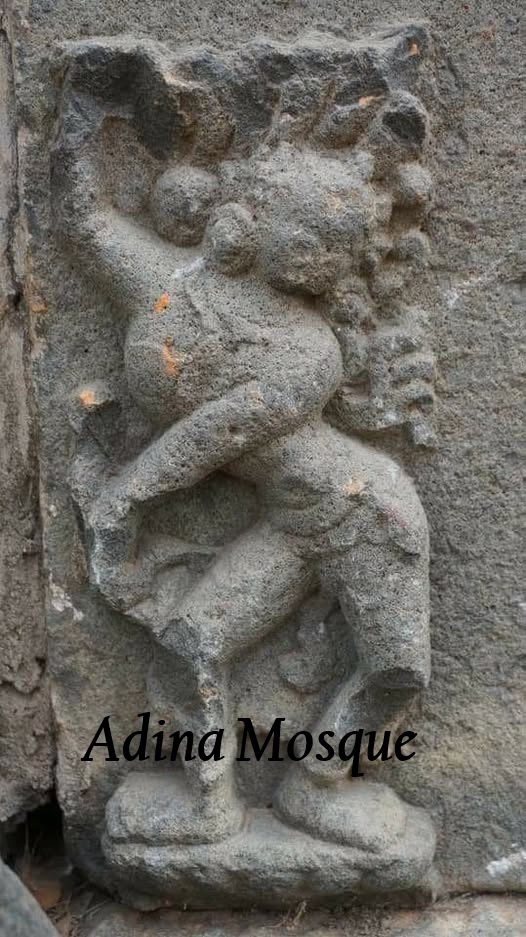
The design of the mosque incorporated Bengali, Arab, Persian, Sasanian, Persianate and Byzantine architecture. It was built with rubble masonry that was covered with brick, stone, coatings of stucco, plaster, concrete, glazing or lime smoothing. Stone flowers were integrated into the arches of the interior and exterior all around the building.(Rf:1&2)
Alexander Cunningham (Rf: 3 &4) visited during 1879-80 and wrote:
I found a line of Hindu sculpture of very fine and bold execution, 71/4 inches in diameter, formed by continuous intersecting lotus stalks. In the complete panels, there are (1) a cow and calf; (2) human figures broken; (3) a goose; (4) a man and woman, and a crocodile; (5) two elephants. The carving is deep, and the whole has been polished, picked from Hindu temples (ARE THESE ARAB-PERSIAN ARCHITECTURE- MIYA BHAI / COMRADE?)
ASI in Bengal (J D Beglar ) surveyed the Adina mosque in 1888 AD and noted.
The West wall of the Masjid is the sanctum of the temple, judging from the remnants of heavy pedestals of statues, now built into the pulpit, and the superb canopied trefoils (flower). There is no doubt whatever that similar trefoils at Kailas over figures of Parvathi.
Ref:
1. Wiki
2. An edition of the architecture and architectural decoration of the Adina Mosque, Pandua, West Bengal, India (1994). By Naseem Ahmed Banerji
Tomb of Hazrat Shah Jalal (RA) at Sylhet, BD:
Shah Jalal Mujarrad (1271 – 1346 AD ) came from Turkey to Kamrup ( the centre of TANTRA) and reached Sylhet, the capital of Raja Gour Govinda, who lost to Shah Jalal, the general of Sikander Shah, in 1303 AD with 360 Sufi-Darbesh.. Sikander Sha is the same who did SICKULARISM at Adinath Temple to Adina Mosque.
During the process of land development, Muslim Pirs entered into uncultivated regions directly, organised the local population for clearing the jungles and later established themselves as local men of influence.
(This is why Muslim and Hindu villages are separate in the entire Bengal)
He was the founder of PIR culture in Bengal, and SATYA PIR (Satya Narayan) was his find. He wore the Brahmin’s sacred thread, the Sufi beard, and wooden sandals, along with the chain belt and dagger of the Gazi, or warrior (defender of God).
“From the fourteenth Century onwards, tawig or amulets (ta‘widh) ( could these be TANRIC adoption?) , Chaddar, Majhar, Darga were made popular in Bengal by him and a team. Khanqahs (infamous as খাঙ্কির ছেলে, khankir chele – meaning illegitimate Muslim child in a Hindu household) and the culture of begging FAKIRs originated in Bengal.
Ref :
1. Sufi, Islamic Settlement and Cultural Synthesis in Bengal by Kalyani Dutta, Department of History, University of Delhi ( research paper Volume-IV)
2. Asim Roy – book ‘The Islamic Syncretistic Tradition in Bengal’.
3. http://offroadbangladesh.com/places/tomb-of-hazrat-shah-jalal-ra/
 subhasmitra.co.in
You must be logged in to post a comment.