
Subhas Mitra: 21 Nov 2025
The Islamisation process in Bengal has no parallels with that of Indonesia & Malaysia, but many similarities can be found in the progress and development of Islam.
1203 AD, when Islam came to Bengal, the Eastern part became a Buddhist majority, while the western part, particularly in the Rarh region (modern-day Bankura, Purulia, and Paschim Medinipur), Hinduism flourished alongside Jainism & Buddhism. 1204 to 1490s was the “Dark Period” for the indigenous population of Bengal. Because neither the public welcomed nor could anyone afford to obstruct. But after the “Mangalkavya Era”, Muslim’s progression in Bengal has many similarities with that of the entire Indonesian peninsula till the beginning of the British rule.
Ashraf and Ex-Hindus (Ajlaf and Arzal / Pashmina) were never on the same page during the entire Muslim rule in India. That’s why kings and priest converts were given Ashraf status. Ashraf is rigid against Kefir forever. The seed of Hindu–ex–Hindu enmity might have been planted by Warren Hastings as the Calcutta Madrassa in 1780 matured in 1906 as the Muslim League. 540 years of Muslim rule did not have any Madrassas outside Friday classes at Mosques.
One of the achievements of EIC Hindu Renascence is that Bengal Hindus were convinced to treat all Muslims as the same, and “Bengal converts” are closer to them than Hindus of other parts of India.
Malay Archipelago:
The entire peninsula shares a common ancestry and socio-cultural and political lineage under the Sailendra Dynasty till 1025 AD, when the Chola Emperor Rajendra I launched a major naval invasion against the Srivijaya Empire, which ruled parts of present-day Indonesia and the Malay Peninsula based in Sumatra that flourished from the 7th to 13th centuries as a centre of Mahayana Buddhism.
This entire peninsular region was fully dependent on China and India for all commercial needs as well as political and spiritual guidance. **
**Ref: George Coedes (1968) Indianized states of Southern Asia (University of Hawaii Press, Pg 246.
The 7th to 12th Century Arabs also joined to form a major Islamic trading hub connecting:
India ↔ Pasai ↔ China…
Gujarat and Tamil Nadu were the earliest, and Orissa and Bengal followed. Chittagong Port was under the Cholas, and they started the First Bank in Bengal and a Currency exchange there. Banking service in Singapura was under Tamil Chattiers even till the late 20th century.
Malaysia:
Parameswara, a Sumatran prince and the last ruler of Singapura, who escaped to the Malay, is the founder of Malacca City (Malay: Bandaraya Melaka or Kota Melaka). He ruled Singapura from 1389 to 1398 and fled during Raden Vijaya’s invasion.
The same person is named in the Malay Annals ** as Iskandar Shah. He was the last king of Singapura and the founder of Malacca.
**According to The Malay Annals (Sejarah Melayu), it is a classical Malay literary work that provides a historical narrative of the Malacca Sultanate, covering its origins. Parameswara, the ruler of Majapahit or “Wilwatikta” (1293 to around 1527), comes from Sanskrit and Javanese terms for the ‘bitter’ (‘pahit’/’tikta’) and ‘star-apple’ (‘maja’/’wilwa’) converted to Islam and became Iskandar Shah in 1402 or 1409 AD.
Raden Wijaya / Vijaya, also known as Nararya Sangramawijaya and his regnal name Kertarajasa Jayawardhana, was a Javanese emperor and founder of the Majapahit Empire (ꦩꦗꦥꦲꦶꦠ꧀, मजापहित,) who ruled from 1293 until he died in 1309..
“Parameswara” became “Iskander Shah” by marrying the Princes of Samudera Pasai.
How Pasai became “sultanate” from “Rajya” (Kingdom) :
The Pasai Sultanate, also known as Samudera Pasai $$, was an early Islamic kingdom on the northern coast of Sumatra from the 13th to the 16th century, founded around 1267 CE by Merah Silu, who converted to Islam and took the name Malik ul Salih. Later: Sultan Malik ul Salih.
It became a key hub for trade and Islamic learning in the region before its decline following the 1521 Portuguese invasion, which led to its annexation by the expanding “Aceh Sultanate” by 1524.
S$ = Samudera is a Sanskrit word, Samudra, and Pasai is the name of a local hunting Dog.
Mehar Silu was the king of the Acehnese people, who were marked by early Hindu-Buddhist kingdoms, the rise of the powerful “Sultanate of Aceh” in the 13th or 14th century.
There are two versions of Merah Silu’s conversion to Islam. ***
1. One, he met Prophet Mohammad in a dream, who asked him to become a Muslim
2. Shaikh Ismail, a holy man from Makkah, met him, and he was influenced by Islam. Merah Silu became Muslim to marry his daughter.
***Ref: Hikayat Raja-raja Pasai (“Chronicles of the Kings of Pasai”), one of the earliest Malay literary works, which blends historical events with mythical elements. His tombstone, dated 1297 CE, is a tangible historical artefact confirming his existence and rule.
Indonesia:
Islam in Indonesia is directly linked to its ports:
Major ports: Gresik, Tuban, Demak and Cirebon.
Till 1478, Islam did not become a threat or an occupying force. Hindu-Buddhist had almost amalgamated with the nature-worshipping tribes, to whom the Abrahamic definition is Animist or Pagan.
Before invasion by Holland, Denmark, Portugal, etc. and their Evangelical hatred against the native population, no historians wrote about any strife between different tribes based on faith or culture, primarily because Islam from the Direct Arab was assimilative.
We have earlier seen the newly converted of Kerala used to light the Deep (Dia /oil lamp at the Temple, turned mosque given to them by Cera King Perumal. In Goa, too, early converts did not discard their Hindu tradition. Bengal too converts practices their Hindu tradition ***(Richard M. Eaton and Khondkar Fuzli Rubbee).
*** The Folk Elements in Hindu Culture, by Benoy Kumar Sarkar, a Longman’s Green and Co publication from London.
The Ming dynasty ruled China from 1368 to 1644; Admiral Zheng He led large naval expeditions between 1405 and 1433, reaching as far as the east coast of Africa.
The primary goals were to display the strength of the Ming Empire and establish a tributary. Chinese settlements started in areas like Semarang, Tuban, and Rembang.
According to “Yingya Shenglan”, a 1451 AD travelogue/book by Ma Huan, his translator, Zheng He took hints from Parameswar, who became Iskandar Shah in 1402 AD and formed the Malacca Sultanate. Zheng persuaded some small Kings of the Indonesian peninsula to become Muslims, though he was not a Muslim, for the expansion of his control.
Arabs and Khoja Muslims of the Kathiawar region of Gujarat, India, were major business allies of Admiral Zheng, who helped in the Islamisation of Indonesia.
Within 50 years, Islam spread, and a Sultanate was formed by a Chinese Admiral.
Demak Sultante :
D S was the first Muslim Kingdom ** formed as Buddhist-Hindu in 1475 and became Islamic in 1481.
The origin of Demak was the settlement named Glagah Wangi, populated by Raden Patah of the Vijaya Dynasty (r. 1475–1518).
This mixture of Chinese Ming Culture, Buddhism, Hinduism and Nature worshipping tradition continued, and they lived in harmony till 17 Aug 1945.
**Ref: Abu Amar, Imron (1996). Sejarah Ringkas Kerajaan Islam Demak (in Indonesian). Kudus, Central Java: Menara Kudus.
Polytheism vs Monotheism:
The Dutch East India Co arrived with cannon and Bible in the 1600s. Perhaps their Pagan/ Gentile hate narratives, and white supremacy and racism began there, as we saw in Calcutta after the EIC takeover.
Till then, Islam‘s “Kefir” had no role in administration or literature/ civil life.
She became an Islamic republic in 1949. Islam became the only state religion, and Churches were allowed, but all others were deprived of state benefits, including employment and welfare schemes.
In 1959, Parisada Hindu Dharma Indonesia was founded, and it obtained recognition for Buddhists in 1965 and Hindus in 1968. Hindus fell to 3% but the Sanskrit language and Hindu/Buddhist vocabularies have not given up to their Islamic Government. Who does not know about the Ramayana or the Sarasvati Statue in front of their US embassy Office?
In contrast, Bengal was invaded and destroyed, and local faith was banned from 1203 onwards till the 1490s. Islamic Bengal is an American vassal state right now, but still, the Muslims use BINDI, touch elders’ feet, and perform last rites (Haram).
A sizeable Bangladeshi intellectual prefers the Indonesian style of multi-religious state with recognition of its Hindu-Buddhist past.
Image:
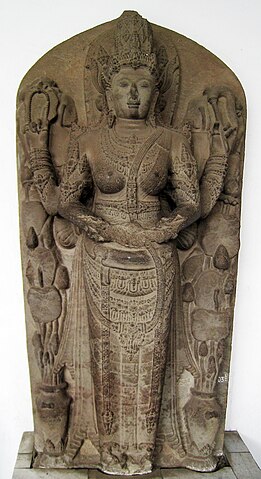
1. Tribhuwana Wijayatunggadewi, known in her regnal name Tribhuwannottunggadewi Jayawishnuwardhani, also known as Dyah Gitarja or Gitarja, was a Javanese queen regnant/empress and the third Majapahit monarch, reigning from 1328 to 1350.
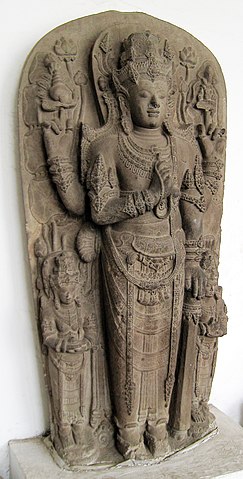
2. Emperor Harihar Majahit
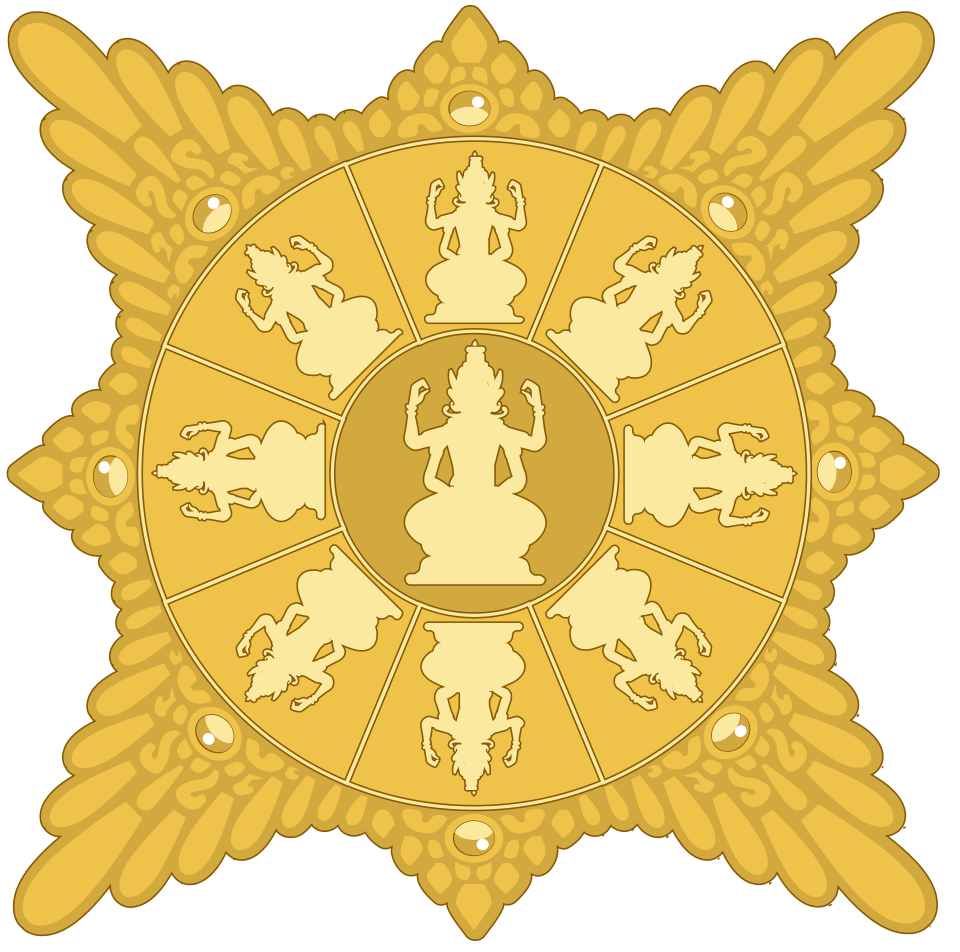
3. Logo of Majaphit and Mallakka
 subhasmitra.co.in
You must be logged in to post a comment.