
Subhas Mitra: 29 Nov 2025
Note:
Rigor de Misericórdia is a Portuguese phrase, an oxymoron or Al Taqiya that means “severity out of mercy” but describes the official policy of forced religious conversion and cultural transmigration.
The Mangalkavya Era is an epoch in Hindu history that marked the end of a 200-year-long solar eclipse for Hindus in Bengal.
The ‘Mangalkavya Era’ of Bengal.
Mangal-Kāvya (“Poems of Benediction”) is a group of Bengali religious texts like Manasā Mangal, Chandī Mangal and Dharma Mangal composed more or less between the 13th (Oral form) and 18th centuries, during the Bengal Sultanate, by more than one author. Alauddin Hussain Shah (1493 to 1519) is regarded as the principal facilitator, who was honoured as Sri Krishna Avatar.
** Ref: Bengali Literature by Annada Shankar Ray and Lila Ray, Paschimbanga Bangla Akademi, Kolkata.
This era was the Second Hindu Renaissance in Bengal, following the first during the Sen Dynasty. Scholars and researchers present different accounts of Hinduism in Bengal from antiquity to the beginning of the Pal Dynasty, when it lost its lustre, including the Varnashrama Dharma and most Vedic Rituals. Buddhist’s tolerance and acceptance of logic through debate helped the survival of Hinduism during the Pal Dynasty. The Sen Dynasty sought to revive Vedic Hinduism through a Cultural Renaissance, but its brief history (164 years) precluded such a revival. That was the First Hindu Renaissance.
1203 AD, when Islam came to Bengal, the Eastern part was a Buddhist majority, while the western part, particularly in the Rarh Bengal (western), Hinduism flourished alongside Jainism & Buddhism. The period from 1204 to 1490 was the “Dark Period” for the indigenous population of Bengal. Because neither the public welcomed nor could anyone afford to obstruct. But after the “Mangalkavya Era”, Muslim progress in Bengal has many similarities with that of the entire Indonesian-Malaysian peninsula until the beginning of British rule in India.
Ashraf (the happiest people during those Dark Days) and Ex-Hindus (Ajlaf and Arzal/Pasmanda) were never on the same page during Muslim rule in India. That’s why Hindu kings and priest converts were given Ashraf status. Ashraf is rigid against Kefir forever. Presumably, the seed of Hindu–ex–Hindu enmity was planted by Warren Hastings with the establishment of the Calcutta (anglicised) Madrassa in 1780, which matured in 1906 as the Muslim League.
Indian First PM’s Madrassa scheme is also on the way to maturity.
**Ref: Ali Riaz, a Bangladeshi American political scientist and writer- Book- Siyasi Muslims: A Story of Political Islam in India.
One of the achievements of the East India Company’s Hindu Renascence is that Hindus of Bengal were convinced to treat all Muslims as equals, and “Bengal converts” are closer to them than Hindus of other parts of India.
Many eminent Hindus, including Kings and Buddhists, had to survive by converting to Islam. Historians believe that, unlike in other parts of Bharat, conversion here was not by the sword but by compulsion and persuasion.
The Mangalkavya Era began when all universities, Buddhist Stupas having been destroyed, the Grand Vishnu Temple became the Zafar Gazi Dargah (1315), and the largest Adinath Siva Temple became the Adina Mosque (1375). Hindus were granted limited liberty to think, cultivate, and practice Hinduism under strict SUFIANA norms of civility and in the Bengali language (Urdu did not yet exist).
It is believed that Sanskrit scholars left Bengal First during the Pal Dynasty and then during the Dark Days of Bengal.
During the East India Company, local Hindus were projected as uncivilised, superstitious, backwards-looking, outdated, idolaters, polytheists and an inferior race in the light of the Bible by superior ‘white’ people.
The leftover “Hindu scholarly”( mostly Brahmans) people humiliated under 540 years of Muslim rule might have lost the ability to defend Hindu knowledge in a colonial environment, that too in an unknown language and mannerism.
Almost all Hindus who learnt English and communicated with the Bible-loving superior Human of skin colour might have accepted it and developed an inferiority complex for not knowing what Hinduism is and how it survived 1051 years of anti-Hindu & antagonistic religious rule before this superior race came.
Some of these English Hindus call Mangalakavyas “Tryst with Islam”. If that is so, then the Brahma Samaj and Hindu School must be considered as “Christianization” of Hinduism.
Why was the English school meant for students of all religions, which was named “Hindu school” (1817 AD)? Perhaps to enrol intelligent kids of influential and well-to-do Hindus who did not convert in the last 1000 years and make them “Scorn Hinduism”. The process is still palpable.
Did the Bible lovers undertake such a development of “human relations” in America, Latin America, Canada, Australia, the Philippines, Africa, and East Timor? There were people like HINDU who lived there when they went there. The answer is No. White people did for themselves and allowed people to join.
Was the Brahma Samaj (1828 AD) formed to eliminate idolatry? Then why, instead of emphasising DHYAN and YAGNA, did they introduce Church seating and a prayer system? What did a cross have to do there?
This rejoinder is not academic or historical ‘Witch-Hunting’ for any author’s views, but to put a rational, logical and philosophical perspective on the same subject.
With the advent of the concept of a Formless, Jealous, Revengeful, and Unmarried lone male God from the outer world, a section of Sanatanis felt it essential to project Indigenous belief systems (Hinduism) as formless monotheistic commandments from this or that book of a Rishi. They are uncomfortable in accepting Hinduism as an ever-evolving system that develops from the ground level of human living and not sent from heaven as a doctrine to form some dogmas.
Our God, who is ‘all in ONE’ and ‘ONE in all’, is with form as well as formless. Bhagwat Gita/15, 9/23, is relevant evidence.
Therefore, any ritual aimed at DIVINITY is part of Hinduism.
American historian Richard M Eaton (a Muslim History specialist) wrote that even after converting to Islam, locals of Bengal practised their native tribal practices and sometimes ISLAMISED tribal rituals. He might not know that Sri Krishna alone has 108 names and manifestations. Lord Shiva also has 1008 Names (Shiva Sahasranama). There is no such thing as “tribal” or “non-tribal.” Yes, you can call Local and global.
Richard Eaton’s account of the persistence of old practices/ customs was relevant across the Malay Archipelago, Goa, and Kerala (including Tipu Sultan). One could see Muslim women with Sindoor in Bihar / Souther WB, and Muslim males in Dhuti-Kurta in Hooghly and Bardhaman districts in WB during the 1980s. Bangladeshi Muslims touch their elders’ feet, wear a Bindi, etc.
Various cultures employed different means to pull out their ‘harvest’ from their native customs/heritage. Somewhere, the transformation processes have been harsh, tenacious, or complex, and elsewhere, smoother. But by and large, no religions seem to have achieved a 100% makeover.
Was “Mangalakavyas_Era a Tryst with Islam?
Honestly, the answer should be both ‘Yes’ and ‘No’.
When it comes to political Islam, the answer is YES. Because that is how Hinduism in Bengal sustained and withstood the Turkish-Mughal onslaughts and their repressions, discrimination and segregation.
When it comes to Islamic Theocracy, there has been no compromise except for the ghomta / ghunggot/veil, the lungi, the pyjama, alterations to some rituals (e.g., shifting marriage timing to the night), and the Persian–Arabic vocabulary.
On the other hand, let us see what Muslim Ashraf Sufis took from Hindu cultures to design native converts as True Muslims.
Over the centuries, Political Islam has changed periodically, but changes in Cultural Islam in Bengal have been less pronounced than those in Political Islam, particularly during the “Sufiyan Era,” which marked the formative period.
Abrahamic deceptions, by and large, remain unknown to Hindus even after centuries of subjugation. The Catholic Inquisition in Goa failed to convert Hindus. Even after conversion, when Hindus were not leaving their Hindu habits, they applied “Rigor de Misericórdia. In Goa, the “Rigor de Misericórdia” was often applied to Hindus or converted Christians accused of relapsing into Hindu customs.
In Bengal, the neo Muslims were also continuing old Hindu culture, but the Ashraf Sufis prevented Muslims and Brahmans from getting close to each other. Brahmana became the “hate target” of both Ashraf Muslims and ordinary Hindus. Binoy Krishna Sarkar, in his book “The Folk Element in Hindu culture”, says Muslim rulers made the known Brahmans do low work that reduced them to “Dom Jati” in Bengal.
However, the Protestant community in Calcutta undertook inculturation and termed it the Hindu Renaissance. Similarly, in Muslim Bengal, Sufis practised Sufi Da’wa, and Hindus experienced the Mangalkavya Era. But the Wahhabi, Salafi was like the Inquisition at sword points.
The main Islamic theological changes were: each affected Bengal.
1. Sufism: 7th- 8th century. First Sufi- 716 AD
2. Wahhabism: 1744 AD
3. Salafism / Muslim Brotherhood: 1928.
Here is the Sufiyana gift to Bengal:
Shah Jalal (d. 1346) — Led the spread of Islam in eastern Bengal and established Sylhet as a major Sufi centre.
Shah Paran (d. c. 1370)
Akhi Siraj (d. 1357)
Nur Qutb-i-Alam (d. 1415) — Guided the Bengal Sultanate through political–religious crises and shaped Bengali Islamic scholarship.
Syed Ghazi Burhanuddin (fl. 14th c.)
Saiyid Ibrahim Danishmand (d. c. 1470–1480)
Madar Shah (d. 1436/1440)
Shah Niamatullah Butshikan (fl. 1480–1520
Here are later imports of Sunni Islam in Bengal:
Haji Shariatullah (1781–1840) and his son Dudu Miyan (1819–1862), Founder of the Faraizi Movement (a Wahhabi), calling for strict monotheism and purification of Bengali Muslim practices. There was a Hindu massacre.
Karamat Ali Jaunpuri (1800–1873) was a significant figure in the Ahl-i-Hadith movement.
Syed Nisar Ali “Titu Mir” (1782–1831) led a militant anti-zamindar, anti-British uprising influenced by Syed Ahmad Barelvi’s revivalist teachings.
Miskin Shah (fl. late 18th century)
Maulana Abd al-Barakat of Jessore (fl. mid-19th century) Ahl-i-Hadith.
Shah Waliullah (1703–1762)
Shah Abdul Aziz (1746–1824)
Mawlana Nazir Husayn (1805–1902), Delhi Ahl-i-Hadith.
(This is not a complete list.)
Hindus of Bengal withstood all these hot and cold Islamic pursuits for 540 years, and the Buddhist majority of East Bengal fell to 46%, while the rest of Bengal maintained 65.7% Hindus when the British took over.
This was not a mean achievement under such Islamic rule. I believe firmly that the Mangalkavya Era’s contribution has been immense. M.E. invigorated the entire body and soul of Hindus in Bengal. This revival of Hinduism encompassed Bengal as a whole, whereas the British-era revival was city-based.
Muslim Era Hindu Renascences in Bengal:
A very vital link between social-cultural evolutions of Bengal remains covered under the glamour of Macaulayan Hindu Renascence (MHR) by European Evangelists in Calcutta, and that of the entire Muslim ruled era if we do not take serious notes from BENOY KUMAR SARKAR’s 1917, LONGMANS, GREEN AND CO., LONDON, published book THE FOLK-ELEMENT IN HINDU CULTURE.
The author clearly visualised “Vedic Hinduism” and Puranic Hinduism or “Brahmanism” and “Native/ tribal Deities Tradition” respectively.
The book insists that when idolatry, idol worshipers’ Temples {Butkhāna (بتخانه) or Al-Bayt al-Dhahab (بيت الذهب)} were decimated and banned (between 1204 and 1490s), Hindus in general did not turn into sitting ducks or Bali ka Bakhra nor all Ex-Hindus ( Ajlaf, Arzal) became patricidal overnight after conversion. Hindus and Sufis switched to trickery to fool one another. Hindus adopted a defensive posture, and Sufis sought to convert covertly through persuasion.
Of course, the situation changed with the arrival of the Sunni reforms. However, no movement on either side became as pan-Bengali as the MHR.
This” mutual tug of war,” a new equation developed in Bengal that continued throughout the entire Mangalkavya Era. The Sunnya Puran of Mahayana Buddhism played a significant role in shaping a heterogeneous literature that supported a socio-cultural amalgamation. Some historians believe it continued till the East India Company’s takeover.
Details in ISLAM IN POPULAR HINDUISM page 219, Hindu Deities in Mohammedan Bengal, Page 221 and RAMAI Pundit, a Folk-Minstrel of Decadent Buddhism (Shunya Purana), Page 189 clearly reveal Hindu & Ex-Hindu tug of war, not violent. Still, former Hindus joined Hindu festivities, but Ashraf Sufis came along their way.
It was at this stage that Buddhists integrated with Hinduism, particularly after RAMAI Pundit’s Sunya Purana replaced Buddhist NOTHINGNESS with Hindu SUNYA/Void/vacant, a concept of a formless Supreme Being as NIRANJAN.
During the Macaulayan Renaissance, Hindus needed the Bible, the Cross, and the Church seating arrangement to prove the formless monotheist BRAHMA. Still, Hindus and Buddhist Pundits of the medieval era did not need the Koran or Crescent to go monotheistic formless SHIVA as Alak Niranjana.
Role of Sunnya Puran :
Shunya Purana, a heterogeneous Bengali text traditionally ascribed to Ramai Pandit from the 12th century CE, The Deer (mrga) is referred to as the “guardian of the forest. For Hindus, it is a “Tiger,” as Shiva is the guardian of the forest, the source of fertility, and the original creator of agriculture.
Based on the original story, “When Maheshwara travelled naked from door-to-door begging for alms with the name of God on his lips, Bhagavati Adya advised him to take to cultivation to grow crops for DHARMA PUJA.
Agama Purana and the Shunya Purana are also Dharma-Puja-Vidhana by Ramai Pundit. Buddhist ‘Dharma’ is the Hindu deity Dharma Thakur (or Dharmaraj), the spouse of various local goddesses, such as Shitala, Manasa, and Ban Devi.
The Buddhist Lord touches the Deer, and it becomes TWO primordial cultivators, Mana and Pawana, symbolised by the Plough Spade and Husking Pedal.
In the South, storytelling is through dance and avinaya (expressive body language), which are part of the Vedic tradition and well-maintained classical forms. In contrast, in Bengal, it is Puranic tales with loosely maintained, free-for-all folk Forms that have changed over time. Some forms have lost out over time.
Here are a few that also have Muslim versions. The grassroots level rural Hindus and ex-Hindus grouped and formed their own system or events, where Brahmans were avoided, and Hindu deities were ridiculed to please the Kazis to escape from their wrath and get permission.
- Gambhira:
Gambhira is a Shiva-worshipper’s event featuring dance and song. Buddhists: called Dharma and Baro- Jananai (Grandmother); Muslims made it Nana (Grandfather) and Nani (Grandmother)
- Gajan:
Gajan is a Shiva worshipper’s festival without an Idol. Hindus replaced idols with certain wooden logs, whereas Buddhists and Muslims used no logs.
- Sahiyatra :
The Shahi Yatra originated as a folk-drama form of the Ramayana, but in Orissa, it was transformed. Bengal Hindus and Buddhists narrated Sanatani themes and stories, whereas Muslims narrated only Islamic/Mughal/Turkish themes.
- Vanafoda: ‘
Vana means arrow (here, the arrow is a verbal attack on each other). Participants followed physical austerity or asceticism practised by Hindu and Buddhist traditions. This tradition of debate songs perhaps became KABI gan (songs of poets with instant composition ability) for Hindus and ‘Jarri Gan’ for Muslims.
- In this form, Natkhat Gopal became Kanu Haramzada (কানুহারামজাদা).
- Neela or Neel:
It is a variation of Gajan and Charak Puja, which culminates on the last day of the Bengali calendar year.
- Naba Barsha and HAL KHATA:
All three communities observed/observe. Hindus do Puja, Muslims do their variation, and Buddhists make PAYASH (sweet rice meal). Here, the Muslim ear constructed a new narrative in which the Bengali calendar began during Akbar’s reign (1556 to 1605). But why did he make only the Bengali calendar when his kingdom covered many calendar zones? Another authority claims it was during KANISK, based on the Plaque of the Mulajore Brahmamoyee Kalibari, Shyamnagar, WB, which was constructed on 31 Baishakh, 1219 Bengali year (1812 AD). Therefore, it may have been initiated by a ruler active around 1007 AD. Probably, Mahipala I of the Pala dynasty or Gobinda Chandra of the Chandra dynasty of Samatata.
Spiritual soldiers of Sanatan Dharma in colonial Bengal:
Abrahamic expansionism works as per their Book(s), while Hindu Spiritual soldiers have no guide/rule book. Each one makes his/her own guidelines and decides how to face the situations.
HINDU ASCETICS / SADHUS WHO PROTECTED HINDUISM IN BENGAL (1203–1800s)
(Chronological order)
13th–14th Century
1. Acharya Madhavendra Puri (c. 1300s): Revived Vaishnavism in Bengal during early Muslim rule and trained the future Gaudiya leaders.
2. Acharya Vidyapati Thakur (1352–1448): Vaishnava identity across Bengal and Mithila.
3. Badu Chandidas (1339–1399): Saved the Hindu culture during the Puja ban by taking Bhakti in oral means by composing & singing Kirtan.
15th Century
4. Chaitanya Mahaprabhu (1486–1533): prevented large-scale religious conversion in rural Bengal and did some reversal too.
5. Advaita Acharya (1434–1559): Key architect of Gaudiya Vaishnavism.
6. Nityananda Prabhu (1474–1532) worked among marginalised groups, preserving Hindu cultural continuity.
16th–17th Century
7. Narottama Dasa Thakura (1532–1607): The Vaishnava movement was strong in Muslim-ruled Bengal.
8. Shyamananda Prabhu (1530–1631) Vaishnava practice in Odisha–Medinipur–Bengal belt.
9. Ramdas Kathiababa (Late 1500s–1600s) revived Naga sadhu presence in Bengal.
10. Bharati Krishna Tirtha (Traditional date c. 1570s–1640s): Advaita and monastic study centres resisting pressure on Shakta–Shaiva institutions.
17th Century
11. Baba Lal Das (c. 1600s): Organised rural resistance to forced conversions in western Bengal.
18th Century (Rise of Sannyasi–Fakir Conflicts):
(This period saw the largest ascetic military defence of Hinduism in Bengal)
12. Ananda Giri (c. 1700s): Naga monk involved in protecting Hindu pilgrim routes and temples in Bengal–Assam.
13. Bhavani Giri (Mid 1700s): Led armed sannyasi groups defending Hindu peasants during Nawabi rule.
14. Satyananda Giri (c. 1770s–1780s): Chief leader of the Sannyasi rebellion in North Bengal against oppressive policies.
15. Bhawani Pathak: (1760–1780): Organised Shakta-ascetic resistance against East India Company revenue oppression. Guru of Debi Chaudhurani
Late 18th–Early 19th Century
16. Atma Ram Giri (Late 1700s): Carried Shakta ascetic networks into rural Bengal to preserve temples under British restrictions.
19th Century Reformist-Ascetics
17. Harichand Thakur (1812 –1878 and Guruchand Thakur (1846-1937): Saved Hindus from the Australian Catholic Mission’s conversion aggression.
18. Ramakrishna Paramahamsa (1836–1886): did not support the Brahmo Samaj as an institution, but never avoided being an individual.
Note:
Bengal had been a land of spiritual leadership and guidance. This list is selected to suit this article only.
Process of Transmigration:
Page 224-228 of the book ibid gives details of cultural interspersed and ritualistic intercourse among Hinduism, Buddhism and Neo Muslim of Bengal.
Image:
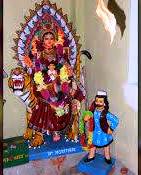

The Image: In the Sundarbans, Hindu devotees offer ‘bhog’ to the Muslim goddess for protection from tigers. This appears in “First Post” written by one Saadia Azim in the 19 June 2016 edition. She, perhaps, was not aware that she was admitting Idol worship by Muslims and that, too, a Female idol without a hijab.
1. Bon Debi বনদেবি, the Presiding deity of Sunderban ( Shakti), became Bon Bibi बॉनबीबीand Dharma Thakur or Dharmaraj or Bon Deb, बनदेवor, or Dakshina Ray (Shiva as Tigar god). Muslims’ acceptance of a Female was not free from contradiction, so they put a SCALP cap on Shiv ji, and Bon Bibi becomes a daughter of a pious man from Makkah. For Buddhists, it is ‘Dharma’ and ‘Adhya’.
2. Ganesh became Gazi Pir.
3. Satya Narayana renamed Satya Pir. Both Hindus and Muslims offers Shinni (সত্য পিরের শিন্নী )।
4. Bairagi (Hindu mendicants) was replaced by Faqir Baba (Non Ashraf Shufi)
4. Behula –Lakhinder episode became Mink Pir, and there were similarities in rituals
5. For Majhis (boatmen), Jai Ma Ganga was replaced by Gazi Badar. Most Hindus even today do not know that Gazi is a Kafir(Hindu) Killer.
6. Shari gan শারি গান (folk song) narrated Ramayana or Manshamangal Kabya became Gazir Geet- they made their own storyline.
7. Baul is not only the latest ‘Cultural Digestion’ by Muslims but also shows Hindus’ callous attitude towards their heritage theft.
West Bengal was born as “Hindu Home Land” in 1947 with 12%+ Muslims, and today the Hindu intellectuals, litterateurs, and politicians have brought it to nearly 40% while in Islamic Bengal Hindus fell to less than8% from 32%+.
To clear this cobweb, ‘Baul’needs elaboration.
The sixteenth session of the Intergovernmental Committee for the Safeguarding of the Intangible Cultural Heritage (ICH) was held entirely online from 13 to 18 December 2021, and the BAUL was recognised as an ICH of Bangladesh.
How and why did BAUL become Bangladeshi?
Background:
The Bauls belong to the Bhakti Marg of Hinduism.
Sanyas (TYAGIS) is one of the four ashrams (Hindu stages of life) that are often confused with BAANPRASTI. Both are part of Hindu spiritual renunciation.
History tells us that when Adi Sankaracharya’s efforts of Hindu unity and sustainability too came under threat, Nayanars (group of 63 saints devoted to Lord Shiva during the 6th to 8th centuries CE and Alvars, Tamil poet-saints, espoused devotion/BHAKTI/ भक्तिमार्ग to the Lord Vishnu or his avatar Rama and Krishna to save Hindus and Hinduism from invading MLECCHAs.
The Bhakti movement is emotion-driven/belief-oriented. They began expressing themselves through poetry and songs, setting aside Mantra, Tanta, Yanta, Haat Yoga, Dhyan, etc. Presumably, this selfless devotion infused a sense of renunciation of GRIHASTA (family) life and of taking Sanyas, but, as sustenance was needed, they adopted the life of a mendicant like Buddha Bhikshu.
Swami Ramananda (the 1380s to 1475 AD) invigorated the movement in central and northern India and founded the BAIRAGI sampradaya, while Baru Chandidas and Chaitanya Mahaprabhu did so in Bengal. Bairagis of Bengal take up “Krishna Bhajan singing” almost like a profession, and soon they faced challenges from Muslims, mainly from mystic Sufis who used to pretend to be Fakirs or Sanyasis, made camps (খাঙ্ক/ khank) in Hindu villages for conversion without violence.
Sri Chaitanya started Gharwapasi in the same coin through song and dance. FOUR Muslims from the Khulna region came home and became preachers of Hare Krishan.
What is Baul Song?
No one can say for sure, but researchers believe that being influenced by Buddhist Bhikshus (life without any responsibility and Buddhist rule in Bengal for nearly 460 years), some Hindus too took up the life of a mendicant and spent time with Yoga (pranayama), composing poetry, music, and singing during the medieval era. They used to be called YOGI or Geoyogi (গেওযোগী), the singing Yogi. These Yogis attributed their singing ability to pranayama, i.e., breathing, i.e., air, i.e., Vayu (বায়ু, बायु). Then there is another Sanskrit word BATUL/ বাতুল/बैतूल, बैतूलmeaning mentally imperfect or পাগল/ pagal. It is from here that the BAUL name originates.
Muslim and Baul :
According to Hadid, Music /song is forbidden like alcohol and illicit sex (we know what a reward for kefir rapping is). Bengal’s Shia rulers encouraged Sufis to build Khank (খাঙ্কিরছেলে), and in this way, many Geoyogis joined Islam as Fakirs. They could not sing traditional Bhajans, so they composed Hindu philosophies in a secular form, in which Shastra/শাস্ত্র became bidhi/বিধি, and Krishna became Bidhata/বিধাতা. These converted geoyogis /fakir too got condemned by Sunnis and faced social boycott / became HARAMI for doing Haram. This is how the popular Bengali proverb geoyogi does not get alms গেওযগীভিক্ষপায়না, ” came to be known to both Hindus and Muslims. They became नघोरकानघाटका– neither Muslim nor Hindu.
Baul Shamprodaya:
In Chaitanya Charitamrita, in its ‘Adi Lila’, Ramananda Roy and Sanatan Goswami address some singers as BAUL and one, “Krishan Bihari”, as MAHABAUL. Bauls, too, had various sects. From Nadia to Khulna, there were many Gharwapasi via BAUL sangkirtan, Pala kirtan, Kabigan, etc. In one such family, Sri Madhab Kar and his wife, Padmavati, gave birth to a son named LALAN. There are TWO versions of this person.
One: He became an orphan in childhood, and Maulana Malam Shah, the Guru of Shiraj Shai (the guru of Lalan Fakir), adopted him.
TWO & popular belief is he was abandoned by his family/friends when he got SMALLPOX, but a Muslim lady served him as mother, and he became Muslim.
The fact is, he grew to become a great thinker, singer, composer, and friend of both rival Muslims and Hindus via this BAUL. His station, where his mortal remains are kept, is neither called a Mazhar nor is there any Mosque; it is known as AKHADA (a Sanskrit word meaning an assembly centre for practice or rehearsal).
From Rabindranath Tagore to a street singer, and from famous composers to the Bauls, no one could avoid the Bauls. It helped preserve Hinduism during the Black Days in Bengal.
Ask any Sunnis if they accept Lalan as Muslim, but the Bangladesh Govt. or Ummah find him very useful to put Hindus in AL Taqiya.
Conclusion:
There is no denying that the Macaulay Renaissance opened a new door to the adoption of Western modernity and Mannerism. Whereas the Manglakavya Renaissance was an adaptation to survival through intricate manoeuvrings that escaped the Sunni onslaught and the eclipse.
 subhasmitra.co.in
You must be logged in to post a comment.