
(Ready Reckoner of Bengal Hindu Binary – Babu Vs Sahib)
Subhas Mitra : 23 Jan 2026
Did Hindutva and the BJP become alien to West Bengal?
Who told?
Bull Hindus of Bengal.
What’s that?
The ‘Vanga’ of the Mahabharata becomes ‘Banga’ in 3 BCE with capital at Pataliputra of Magadha, the Gupta Empire of Samudra Gupta in 4 AD, Subh-e -Bangal in 1203 AD and Bengal in 1757.
Hindus were granted permission to stand up in supplication before the British and to ‘look up’after centuries.
Bull Hindus: ****
Hinduism without its ‘Tatva’तत्त्व (ta + tva + va)or তত্ত্ব(Tattwa) or essence and spirituality is like an OX without its Testicles. As bulls are more useful for farmers than an Ox, similarly, these Bull Hindus were more useful for colonial masters. The name was definitely degrading thus were called “scientific Hindus” and those who did not join the band wagon were called out dated, superstitious Hindus.
East India co.’s superstitious Hindu employees were taunted as BABOON, which was soon taken as complimentary- BABU***. Those scientific Hindus who accepted British attire, language, mannerisms, and religion were called SAHIB.
Subsequently, the term ‘Bengali Sahibs’ was elevated to the All-India BROWN SAHIB. Thus, Bull Hindus = BS became Brown Sahib = BS
*** taken as fiction.
The founders of this “scientific Hinduism” are primarily William Jones, Max Müller, and Raja Ram Mohan Roy. These Hindus were Britain’s assets and are still dominating politics, education, and the media.
However, there was an organic collateral development from multiple angles, but consolidated as follows:
Historical Timeline Modern Hindus (1815–1830)@@
Buddhist Rule: Pal Dynasty: 750–1161 CE, to end the Matsyanyaya.( literally means “fish-law, or “might is right”.) .
Hindu rule: The Sena Dynasty: 1070 to 1230 CE.
Muslim Rule: From 1203 to 1757.
EIC: and British Raj: 1757 and British Raj 1858-1947.
1815: Atmiya Sabha: Founded by Raja Ram Mohan Roy (RRR) as a private intellectual discussion group.
1817: Hindu College : Founded by David Hare, Radhakanta Deb, and Baidyanath Mukhopadhyay. Ram Mohan Roy was a silent partner; he intentionally kept his name off the official list of founders to prevent the orthodox Hindu community from boycotting the institution. (Changed from ‘Hindu boys’ to ‘any religious boy’).
1820s–1830s: The Young Bengal Movement by Henry Louis Vivian Derozio was Eurasian (Anglo-Indian).” He was a Radical Free-thinker and a poet. He was no less than an evangelist for a devout Hindu, though through Atheism, Rationalism, and Scepticism.
1825: Vedanta College: RRR founded this to bridge the gap between traditional learning and Western science. This was a “forebear” of the Ramakrishna Mission in the Neo-Vedantist tradition. RRR removed Vedanta from the monastery and brought it into the social/academic world; Vivekananda later took it a step further by adding “Practical Vedanta” (social service).
1828: Brahmo Sabha: The Brahmo Sabha of RRR’s concept was Brahman (the formless Absolute) perhaps heavily influenced by the European Renascence particularly the “Unitarian church” as it is a liberal religious community, often part of Unitarian Universalism, that emphasizes reason, individual spiritual growth, and social justice, distinct from mainstream Christianity by rejecting the Trinity and focusing on God’s oneness.
1830: Dharma Sabha***: founded by Radhakanta Deb, stood for the basic Hindu concept to defend orthodox Hindu customs. It was socially conservative; modern in its methods. It used the press and petitions to organise the Hindu community, marking the beginning of organised “Hindu politics.” It supported Western education, provided it didn’t interfere with religious beliefs.
It stood for the defence of Hindu self-determination against British legislative interference in religious customs. It is often cited as the birth of “Constitutional Conservatism” in India.
(No wonder J Sai Deepak picked up this year as the basis of his Hindutva debate in Kolkata)
1839: Tattvabodhini Sabha: Founded by Debendranath Tagore. It acted as a bridge between the radical Brahmos and the orthodox community.
@@ References:
1. David Kopf, British Orientalism and the Bengal Renaissance: The Dynamics of Indian Modernisation, 1773–1835.
2. Amiya P. Sen, Hindu Revivalism in Bengal, 1872-1905: Some Essays in Interpretation. (Crucial for the link between RRR and the Ramakrishna Mission’s Neo-Vedantism).
1866: imagery of “Bharat Mata” in plays by authors like Ashutosh Mukhopadhya.
1867: Debendranath Tagore realised that the ‘Brahma” was being hijacked by Christ and His Father. He established the Hindu Mela (later the Jatiya Mela).
1875: Vande Mataram was composed by Bankim Chandra Chattopadhyay
1882: Sri Ramkrishna on Brahama Samaj : 1. October 28, ‘I am bound, I am bound’ only succeeds in being bound. He who says day and night, ‘I am a sinner, I am a sinner’ verily becomes a sinner.” Stop obsessing over “sin” and logic.
@Reference: The Gospel of Sri Ramakrishna, Chapter 7: “With the Devotees at Sinthi.”
2. April 1882: He compared them to people who count the leaves on a tree instead of eating the fruit. “Dive deep” into direct experience.
@Reference: The Gospel of Sri Ramakrishna, Chapter 4: “Advice to the Brahmos.”
1892: Chandranath Basu utilised the term “Hindutva” as Hindu Dharma and “Tattwa” (essence).
1896: Rabindranath Tagore sang Vande Mataram for the first time.
1888: Bankim Chandra Chatterjee wrote an essay, “Anushilan”,
1893: Swami Vivekananda, in Chicago, highlighted his views on the history of invasions in India.
1902-1909: Sri Aurobindo: established the “Anushilan Samiti “and in 1902 and emphasizes Sanatana Dharma with nationalism at Uttarpara speech in 1909.
1905: First image of Banga /Bharat Matha drawn by Abanindranath Tagore.
1907: Rishi Arobindo on Brahma Samaj :
Failure of Artificial Unity (23 September 1907): In an editorial in the Dainik Vande Mataram,
He called their approach to social reform (like inter-communal dinners) “unphilosophical” because it provoked the orthodox without offering a deeper spiritual solution. Lack’s Spiritual Foundation. •Calls for Return to the “Sanatana Dharma” and original spirit.
@ Reference: The Foundations of Indian Culture.
1911: Rabindranath Tagore composed and first sang Jana Gana Mana on December 27th, with his niece Sarala Devi Chowdhurani leading the performance.
1918: 2. Brahmo Samaj was a “crude and confused imitation” of European culture. He believed it was a movement of the “denationalised” middle class who tried to reform Hinduism using Western standards of logic and morality.
@Reference: The Renaissance in India (originally published in Arya, 1918).
1943: Netaji Subhas Chandra Bose hoisted the flag of free India at Andaman on December 30, 1943.
1944: Netaji’s Indian National Army (INA) hoisted the national flag in Moirang (Manipur/Imphal).
1947: Dr Syama Prasad Mukherjee moved the Bengal Legislative Assembly for the creation of a Hindu Homeland for Bengal Hindus, which was passed on 20 June 1947, and passed by 58–21votes.
1950: The original Indian Constitution was hand-illustrated by Nandalal Bose and his team from Shantiniketan.
2012: Pranab Mukherjee became the 13th President of India on July 25, 2012. BJP Govt. Awarded 2019: The BJP Government awarded the ‘Bharat Ratna’ to Pranab Mukherjee.
Hindu politicians of West Bengal are calling “BJP and Hindutva” as outsiders’ ideology for Brown Sahib Hindus, and REAL Hindus are in hibernation for fear of international factors of JAI Bangla.
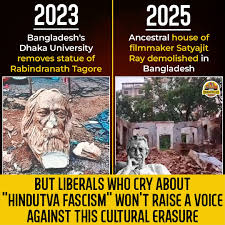
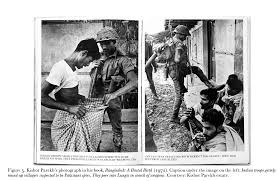
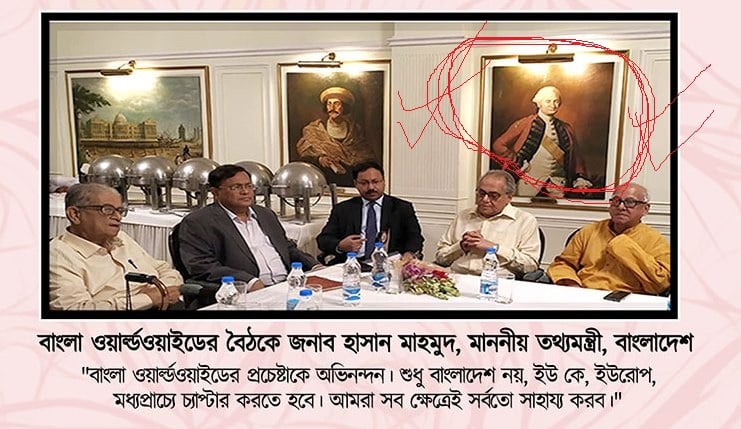
Perhaps this could be due to the effects of the gift of BS Hindus:
• 1946: Calcutta Killing – Brown Sahib Hindu shared Dias with Jinnah.
• Despite NOAKHALI, one of them joined the Muslim League. October 1946.
• One who was sitting with Jinnah on direct action day ruined the state’s economy and work culture as CM and made Local Hindus unemployable and dole seekers.
• Another ruling on the power of the dole and the strength of voters of economic refugees, and the milk-giving cow theory.
• 2019: Nobel Laureate Amartya Sen at New Yorker interview, (The New Yorker/TBS News): argued that “multiple identities have done a lot for Bangladesh” and that it had become “in many ways, more successful than INDIA now”.
• 2020: Nobel laureate Abhijit Banerjee stated that the “fear of a Muslim takeover in India” is baseless and a way to “demonise a population” on January 27–28, at the Tata Steel Kolkata Literary Meet.
• 2025: In March 2025, while commenting on the crisis in Bangladesh, Sen reaffirmed his view that “Bangladesh has historically taken pride in its treatment of minorities, keeping communal forces in check.”
• 2026: 12 January, TMC MP Mahua Moitra, in a debate in Kolkata, arguing that Hinduism needs protection from the political ideology of Hindutva, which Congress leader Mani Shankar Aiyar described as “Hinduism in paranoia”.
**** based on online search and Speech by Supreme Court lawyer J Sai Deepak in Kolkata, Jan, 2026
Gift of secularism: from Aponjan. file:///C:/Users/User/Desktop/Bangladesh/Anti_India_Anti_Hindu_Rhetoric_Bangladesh_2024_2025%20(1).pdf
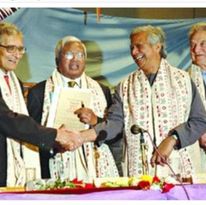
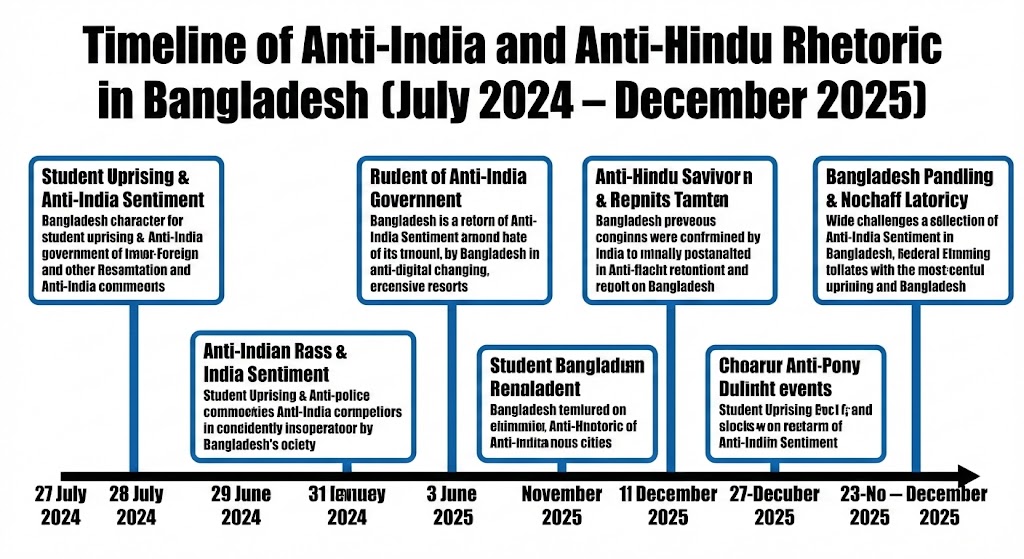
Here is ACTULA Bangladesh in their “own media”:
Bangladesh:
The following timeline provides a brief overview of the violence against the Hindu minority in Bangladesh following the ousting of Sheikh Hasina, based on reports from Bangladeshi and Western media.
2024: The Aftermath of the Ouster
August 5–20: Following Sheikh Hasina’s resignation, minority groups reported over 2,010 communal attacks across 45–52 districts, including arson, looting of homes, and the deaths of at least 5–9 Hindus. (Sources: The Daily Star, Prothom Alo, Reuters)
August 7: The house of celebrated Hindu musician Rahul Ananda was torched in Dhaka, and rights groups reported at least 10 temples were attacked within 48 hours. (Source: The Hindu, AFP)
October: During Durga Puja, the government reported 35 “untoward incidents,” while minority groups held massive rallies in Chattogram demanding an 8-point charter of rights for protection. (Sources: Dhaka Tribune, India Today)
November 25: Hindu monk Chinmoy Krishna Das (spokesperson for Sanatan Jagaran Mancha and a former ISKCON member) was arrested at Dhaka airport on sedition charges for allegedly disrespecting the national flag. (Sources: The Daily Star, BBC)
November 26: Violent clashes erupted in Chattogram after Das was denied bail, resulting in the killing of lawyer Saiful Islam Alif and injuries to several protesters. (Sources: bdnews24, Al Jazeera)
December: International monitoring intensified as the UN and India expressed grave concern over “recurring attacks” on homes and businesses belonging to minorities. (Source: OHCHR, The Hindu)
2025–2026: Ongoing Unrest and Legal Proceedings
January–April 2025: Local reports indicated a total of 1,700+ incidents of vandalism occurred in the months following the transition; Chinmoy Das was eventually granted bail in late April. (Sources: US Commission on International Religious Freedom, Wikipedia Archive)
May–December 2025: Vandalism of idols and temple properties persisted, with the Bangladesh Hindu Buddhist Christian Unity Council (BHBCUC) recording 51 communal incidents in December alone, ahead of planned elections. (Source: The Hindu, January 2026)
January 19, 2026: A Chattogram court indicted Chinmoy Krishna Das and 38 others for the murder of the lawyer during the November 2024 protests, marking the start of a sensitive trial. (Source: PTI, The Tribune)
Current Status (January 2026): The BHBCUC reports that between August 2024 and early 2026, total deaths of Hindus in communal violence have reached approximately 82, with over 2,600 reported “atrocities.” (Source: Prothom Alo, January 2026)
Would you like me to look for specific details regarding the upcoming 2026 general election and its impact on minority safety?
The following timeline highlights reported incidents of forced resignations of Hindu teachers and government officials, as well as broader targeting, based on reports from Bangladeshi and international media.
Timeline: Forced Resignations & Professional Targeting
August 5–15, 2024: Immediately following the ouster, mobs and student groups across districts such as Dhaka, Barishal, and Gopalganj targeted school and college heads; reports emerged of teachers being publicly humiliated or “garlanded with shoes” to force their exit. (Source: Prothom Alo, The Daily Star)
August 31, 2024: The Bangladesh Chhatra Oikya Parishad (a minority student wing) held a press conference stating that at least 49 minority teachers (mostly Hindus) had been forced to resign through intimidation across the country since August 5. (Source: The Daily Star, Dhaka Tribune)
September 2024: The Hindu and local media reported that hundreds of high-ranking officials and educational heads perceived as “pro-Awami League” (including many from the Hindu community) remained out of their posts due to “mob-driven” forced resignations. (Source: The Hindu)
September 3, 2024: In response to the wave of resignations, the Interim Government’s Ministry of Education issued a directive stating that forced resignations were not legal and should not be accepted, though many teachers remained unable to return due to local threats. (Source: bdnews24)
October 2024: Reports surfaced from rural districts (e.g., Satkhira and Bagerhat) of Hindu government staff in local administration and health sectors being pressured to take “voluntary leave” or face physical harm. (Source: Bangladesh Hindu Buddhist Christian Unity Council – BHBCUC)
January 2026: Recent summaries from the BHBCUC indicate that while some teachers were reinstated after government intervention, a total of over 2,600 “atrocities”, including job loss and property seizure, were recorded between August 2024 and late 2025. (Source: Prothom Alo, January 2026)
Summary of Atrocities (August 2024 – January 2026):
Total Deaths: Approx. 82 Hindus killed in communal/political violence.
Forced Resignations: At least 49 Hindu teachers were documented in the first month alone; hundreds more were displaced.
Temple Attacks: Over 152 temples desecrated or attacked.
 subhasmitra.co.in
You must be logged in to post a comment.