
Subhas Mitra: 30 Jan 2026
Why did the British open a Sanskrit college in Calcutta?
Those Hindus who think the British wanted to learn the Santana Dharma, or that it was part of the Hindu Renaissance, go to sleep; do not waste time reading this.
Answer:
1. They knew:
1031 AD: Al-Biruni wrote in his Kitab-ul-Hind:
Here is a part of Chapter 1 : ( as available online) :
Arabic (Original)
“ويعتقدون أنه ليس في الأرض بلد غير بلدهم، ولا أمة غير أمتهم، ولا ملوك غير ملوكهم، ولا دين غير دينهم، ولا علم غير علمهم. فهم في غاية الأنفة، ونهاية التعصب، ويستصغرون ما عند غيرهم.”
English (Translation by Edward Sachau)
“The Hindus believe that there is no country but theirs, no nation like theirs, no kings like theirs, no religion like theirs, no science like theirs. They are haughty, foolishly vain, self-conceited, and stolid. They are by nature niggardly in communicating that which they know, and they take the greatest possible care to withhold it from men of another caste among their own people, still much more, of course, from any foreigner.”
His vocabulary for describing Hindus was of utmost significance.
• Varnasharam division: the social stratification through the lens of الطبقات (al-ṭabaqāt – the classes) and the مراتب (marātib – ranks).
( Caste word did not enter India).
• Sanskrit: Linguistic complexity – as اللغة (al-lugha).
• How Hindus looked at Muslim raids: the deep-seated resentment following the raids as النفور (al-nufūr – aversion or alienation) and الوحشة (al-waḥsha – estrangement).
• Insularity: sense of self-superiority using terms related to الأنفة (al-anafa – pride/disdain) and التعصب (al-ta‘aṣṣub – fanaticism/zeal).
Why Islam failed in Bharat, as per the book :
Barriers” (akhshat- “al-ḥawājiz,”- أسباب) to “Islamization” of India:
• Language: Sanskrit was an incredibly complex language
• Religious and Social Radicalism: Hindus and Muslims were “totally different” .
• The Varna system: the message of Islam found it difficult to be absorbed into the existing social fabric.
• Notions of Purity: Concept of Mlechcha (Hindus often avoided physical contact, dining, or intermarrying with Muslims and treated a Muslim convert as ‘Mleccha’ and curbed inheritance of even their own family members. (Effects of Hindu Jurisprudence).
• Historical Trauma (The Raids of Mahmud), Xenophobia and Insularity.
Note: These were the KABAZ (shield) that saved Hinduism during Muslim rule. (see also see page….) Protestant conquest of Bengal‘s FIRST priorities might have been to break those Hindu qualities that saved them from Ghazwa-a-Hind of centuries.
The Hindu Renaissance was the stepping stone, and the college was its research laboratory.
The Calcutta Sanskrit College seems to have been a निचोड़(Squeeze) Centre of Hindu jurisprudence (धर्मशास्त्र, न्याय, औरव्यवस्था(विधि). The British took control of the land and its people at the Plassey Battle ground, but control over the ‘Hindu Mind’ was taken at this college that became an all-purpose Research Laboratory to understand how this civilisation survives 800 years of Jihad and Ghazwa-a-Hind.
Perhaps TB Macaulay initially failed to understand it and objected to its formation, but by 1835, he had attained a commanding position.
The Macaulay Minute (February 2, 1835) ***
Following Macaulay’s Minute, Lord William Bentinck (the Governor-General) passed the English Education Act of 1835 to produce English-speaking clerks and subordinates for the British bureaucracy. Soon, English replaced Persian as the official language.
. Sanskrit College (1824–1835) played its role.
1. Against:
a. When Macaulay visited the Sanskrit College, it was a centre for jurisprudence (Nyaya) and logic. The British were already using it for a specific administrative purpose.
b. That Raja Ram Mohan Roy had objected to the setting up ofthe Sanskrit College because he believed education should be Western, and that it was Ishwar Chandra Vidyasagar, the father of the modern Bengali alphabet, who insisted that English be taught in that college.**. RRR wrote a letter to Lord Amherst.
c. Macaulay objected, saying Nyaya (Logic) was absurd metaphysics. Sankhya and Vedanta are “unproductive.”
**Kolikata Sanskrit College-er Itihas (‘History of Kolkata’s Sanskrit College’) Part 1 authored by Brajendranath Bandyopadhyay,
2. In favour:
1811 Lord Minto’s Minute: First official British suggestion to fund Sanskrit learning.
a. The General Committee of Public Instruction (GCPI) Reports (1823–1841 found the college useful for EIC.
b Radharaman Mitra wrote in “Kolkata Darpan”, Parba-1, about how the local intelligentsia supported.
c. Horace Hayman Wilson was the Academic Architect and the secretary.
d. Before Vidyasagar (1851), the college was strictly for Brahmins and Vaidyas. He opened it for all. ( And Church blamed Brahmin for all the ill).
e. William Adam’s Findings (1835–1838) were the most eminent. He was a Scottish missionary & architect who travelled the Bengal and Bihar districts in the 1830s. He delivered a report on educational development in vernacular schools. According to him, the PATHSHALA educational system was highly adaptable, and local schools were referred to as such.
He reported in 1835 that he visited one lakh villages, each with a Pathshala. Schools closed during harvest, facilitating even poor students’ attendance.
They were not just for the Brahmin elite. A significant number of students and even teachers came from “lower” castes (such as Malo, Chandal, and Kahar), showing a much broader reach than the British “elite-only” model
.
****Based on online search and:
• Zastoupil and Moir (1999): The Great Indian Education Debate. This provides the original documents of the Orientalist-Anglicist controversy.
• Gauri Viswanathan (1989): Masks of Conquest: Literary Study and British Rule in India. This explores how English literature was used as a tool of social control.
• ‘Reports on the State of Education in Bengal (1835, 1836, 1838)’ by William Adam. Ed. Anathnath Basu, Calcutta University
‘Lobotomized’ Sanskrit collage:
With ‘Dharma’ becoming ‘Religion’, Dharma Shastra became “Hindu Theology” (from Jurisprudence), and Macaulay’s English literature lobotomized the Sanskrit collage to an English law factory.
Many historians (such as Bernard Cohn and Nicholas Dirks) argue that the British did not merely “study” India; they “codified” it to make it governable. By establishing institutions like the Sanskrit College in Calcutta, they effectively centralised and “state-approved” certain interpretations of Hindu law.
It was Hindu Law that shielded Hindu Bharat, and it was British law that made Bharat a Dharma Shala or an ‘Inn’ called India.
It may be useful to briefly outline the evolution of the education system in British India.
On critical analysis, it can be said that European missionaries and the British administration worked in concert, albeit not anonymously. ***
1. Jonathan Duncan was a prominent East India Company (EIC) official, an Orientalist who believed that the “ancient and valuable” Sanskrit literature was in danger of decaying. He wanted to systematise the study of the Vedas, Puranas, and Nyaya (Logic). He served as the Resident at Benares and Governor of Bombay. On his recommendation, Lord Cornwallis grants Sanskrit College to Pundit Kashinath (currently Sampurnanand Sanskrit Vishwavidyalaya) in Varanasi in 1791. He learnt Persian and Bengali before Sanskrit. He believed in educating Indians in vernacular languages.
2. Willum Carry, the missionary, felt spreading Jesus through then existing education system through the local language would be easier, and thus came out with the First Bengali Bible in 1801.
3. Lord Minto’s 1811 Minute emphasised that indigenous education was in a state of “decay”. He proposed that the British government, as the new power, should step in to fund the education of Hindus and Muslims. He specifically argued for establishing colleges at Nuddea (Nabadwip) and Tirhoot and for assigning libraries to each college, which was a major formal step toward funding oriental studies, including Sanskrit. It was later reinforced by the Charter Act of 1813.
4. William Adam, a Scottish missionary, arrived in India in March 1818. Worked with Ram Mohan Roy and formed the Calcutta Unitarian Society. He preferred education in Sanskrit and vocabulary. Ram Mohan Roy differed. It was TB Macaulay’s 1935 minutes thing that changed.
5. Persons Contributed in evaluating the importance of Sanskrit as both a language and a literature in Europe were:###
• Filippo Sassetti learned Sanskrit in the 1580s.
• Heinrich Roth -1654–1662,
- Johann Ernst Hanxleden wrote Sanskrit Grammar in 1732,
• William Jones -1786 took to England. Of course, interest increased only when the original manuscript began to reach Western academics.
Could it be possible that a civil servant like Machaulay did not know the value of Sanskrit?
###- Indian Beyond Narrative Page 61 and online search
. 6.. Wood’s Despatch of 1854 or Magna Carta of English Education in India:
The Woods Despatch refers to the educational reforms introduced in India, as outlined in a dispatch sent by Sir Charles Wood, then President of the Board of Control for India, to Lord Dalhousie in 1854. It laid the foundation for the modern education system in India during the colonial period. While Macaulay focused only on a narrow elite (Brahmins and Vaishyas), Wood’s Despatch aimed to create a structured, nationwide hierarchy of education for all.
For want Fund Gurukuls were dying out from 1935 to 1954, and illiteracy multiplied in rural Bengal/Bihar. Macaulay made English education elitist. A great relief came with Wood’s dispatch. He proposed the “Grants-in-Aid” System for educational infrastructure.
· Primary Level: Vernacular schools in villages.
· Middle Level: Anglo-Vernacular High Schools.
· Higher Level: Affiliated Colleges and Universities in presidency towns..
· 1857: Calcutta, Madras and Bombay get British-type universities.
*** 1. British Education System In India – Features and Impact – Vajiram & Ravi
2. S.N. Mukerji: History of Education in India (Modern Period). This provides a clear technical breakdown of the 1854 administrative changes.
3. B.K. Boman-Behram: Educational Controversies in India. A great source for the “behind-the-scenes” political motivations of Charles Wood.
The entry into Hindu jurisprudence:
1. The “Information Order”: Mapping the Hindu Mind
Before the British arrived, Hindu law was fluid, localised, and interpreted by various pundits based on regional customs. The British found this “unreadable.” They felt the need for a “Fixed Code.
Warren Hastings commissioned the Vivada Chintamani (translated as A Code of Gentoo Laws) in 1776 to take the law from Hindus to British law officers.
2. The Creation of the “Court Pundit” (A Government Employee)
The British transformed the “Pundit from an independent scholar” into a salaried government official. If a pundit wanted a prestigious job at the Sadr Diwani Adalat (High Court) or a teaching position at the College, their interpretations had to align with British legal principles of “certainty” and “precedent.”
They preferred scholars such as Mrityunjaya Vidyalankar, who provided the specific scriptural justifications the British required.
(This is something Congress, DMK, Communists and their franchisees are still practising)
Image court Pundis :
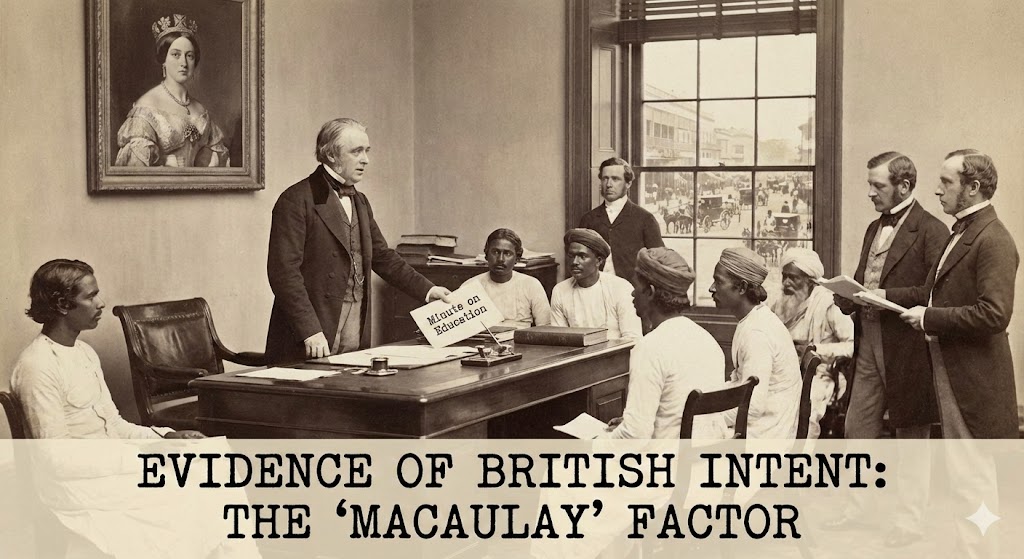
3. Fossilising the Shastras:
In the traditional system, Hindu law changed over time through Achara (custom). The British-led “Sanskritization” of law through the college actually froze Hindu law. The British took a living, breathing tradition and turned it into a static “book religion.”
The “Macaulay’s Minute on Education” (1835), his goal for the legal system was similar.
Salaried Pundits shifted loyalty from the local community to the Colonial State. The Pundit became a cog in the colonial administrative machine.
“Manusmriti” versus British Indian Hindu laws:
We have seen how the Sanskrit Pundit became or was replaced by “English Hindu scholars”.
Here, one may find how and from where some Hindus got the “Manusmritu Burning ceremonies” in Universities.
1. German philosopher Friedrich Wilhelm Nietzsche (1844 –1900) argued that the Manusmriti was a “life-affirming” law book that recognised the natural order of human hierarchy, contrasting it sharply with the “life-denying” morality of Christianity in his works- The Antichrist (1888) and Twilight of the Idols (1889).
Nietzsche famously wrote, “Close the Bible and open the Manu Smriti.”For him Bible was based on the “resentment” of the weak, the Manusmriti was based on the “will to power” of the strong.
While the British in Calcutta used the Manusmriti to limit and codify the Hindu mind for administrative control, Nietzsche used it as a philosophical weapon to attack the foundations of Western Christian civilisation.
Hindu Reform Acts (1843–1891):
Sati and Widow Remarriage are over propagated and discussed, and hence being omitted here to show how the British or Church of England or Deep State put Hindus in DEEP SLUMBER by OMITTING those facts which could reflect the worth of Sanatan Dharma and Values they have not only ‘Used and Thrown’ but also DISTORTED and deleted from the Hindu Mind.
Whenever we talk about Hinduism, we are prone to draw a comparison with the Abrahamic coloniser’s point of view. Primarily because Muslim rulers followed their Prophet’s path –”Break Temples, Idols, kill those who refuse to accept and destroy anything that comes on its way”. Thus, Islam did not occupy space in the Hindu Mind except under imposed conditions.
Europeans came from a background where, in 1633, Pope Urban VIII punished Galileo Galilei for life imprisonment and to recite the Seven Penitential Psalms once a week for three years for “vehemently suspect of heresy” for defending Heliocentrism—the theory that the Earth moves and revolves around the sun.
Yet they conquered the world. How and why?
We forget that the adage “The sun never sets on the British Empire” was not derived from the Bible. They developed their human endeavour to prevail over one-fifth of the globe and to achieve blue-water domination.
It was their ability to think ‘Out of the Box’ by challenging Papal authority wherever necessary. Protestantism was not one man’s one-time wish. It began in the 16th century, when papal authority was challenged, and a Brutal Rebuttal followed.
1. The Waldensians (12th Century): Led by Peter Waldo, they preached “poverty and the Bible” as the sole authority. They survived centuries of persecution and eventually joined the Reformation.
2. The Hussites (1415): Following the execution of Jan Hus (c. 1369–1415), a Czech theologian, Catholic priest, and reformer who, influenced by John Wycliffe, criticised church corruption and the sale of indulgences. His followers in Bohemia (Czech Republic) successfully fought the “Hussite Wars” against the Pope’s crusades. ( In Goa, India, it was only an inquisition, not a crusade.
3. The Break (1534): It was established when King Henry VIII passed the Act of Supremacy, formally breaking with the Pope. Established Church in England, meaning the reigning monarch is its “Supreme Governor.”(This is why in this book East India co. is sometimes marked as Church of England).
4. The Unitarian Church: 1774 (UK) / 1825 (USA): with One God- no Trinity, Reason, Conscience, and Science, Congregational (Each church is independent), historically “Dissenters” (outside the state system).
Unitarian is the Church of Raja Ram Mohan Roy and the base of all Hindu reforms.
Many Sanskrit and Vedic scholars argue that Sanatan Dharmi( Hindu) need not break away from Hinduism, as there have never been centralised, rigid papal authorities in India. Atheism, Resent, Dissent, Questioning, Debating and Science were all inbuilt.
Muslim rule adversely damaged Sanatan Dharma, which did need reform but not Christianization or ‘Churchification’ in any case.
However, it was this IQ, EQ and sense of superiority that helped them develop unique skills in management, adjudication, planning and implementation.
Eight centuries of battering, persecution, suppression, and subjugation of Hindus made them in need of learning those skills and absorbing them, rather than aping and mimicking the English and the church, by forming Hindu Sabha, Brahma Sabha, Sikh Sabha, Dravida Mahajana Sabha (1891), and Dravidar Kazhagam (1944).
In page no…… discussed Hindu Renascence by evangelist and here are the reforms they did in Calcutta for “white wash” (infused adoptability) Hindu mind.
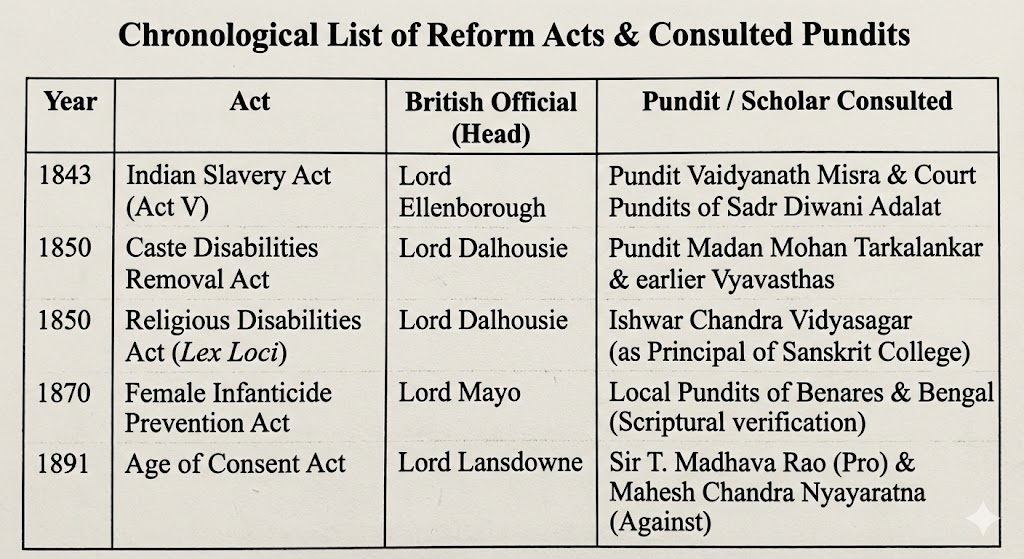
1. Abolition of Sati (1829): (details in Page…..)
Lord William Bentinck on 8 November 1829. Wrote:
“…and by a vast majority of those people throughout India the practice is not kept up nor observed: in some extensive districts it does not exist; in those in which it has been more frequent it is notorious that in many instances acts of atrocity have been perpetrated…”
2. Slavery Acts: How the “English” Language deformed Indic vocabularies.
They created slavery and abolished it just like SATI.
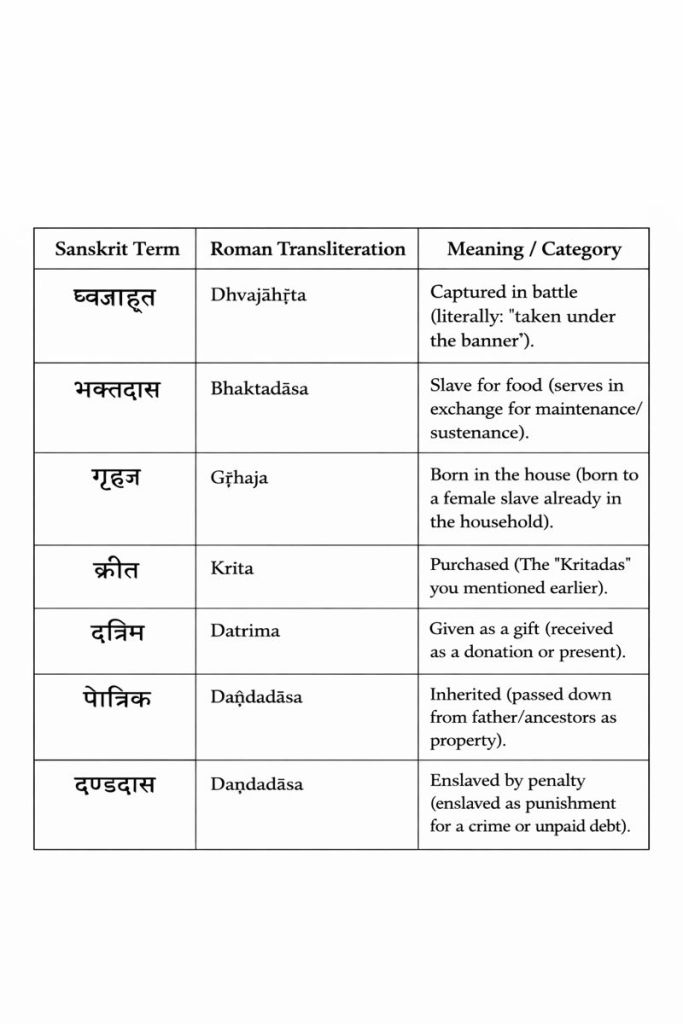
In the Dharmashastras, Dasha denotes a SEVAK (Bhritaka) or BHRTTVA (servant). The Manusmriti (Chapter 8, Verse 415) lists seven types of Dasas. (See chart for Sanskrit)
Originally, the term Das was broader and denoted a “servant,” “devotee,” or “subordinate”. Kalidas, or ISKCON Dasas, are not slaves.
• Dhvajahrtah: Captured in battle.
• Bhaktadasah: One who becomes a dasa for food/maintenance?
• Grhajatah: Born to a Dasa woman in the house.
• Kritah (Kritadasa): The one who is purchased.
• Datrimah: Given as a gift.
• Paitrikah: Inherited from ancestors.
• Dandadasah: Used as dasa as a punishment for a crime or debt.
In no scriptures is a Dasha ia one’s property, nor the body of a Dasha, the community did not fit the brutal, industrial “chattel slavery” ***model of the West.
The chattel refers to any item of tangible, movable property. In modern contexts, it might refer to simple assets such as furniture or cars. It is The Dehumanization of the Person. In Western chattel slavery, the status of “chattel” was often hereditary.
***1. Patrick Olivelle (The Definitive Modern Authority) and
2. P.V. Kane (Westernised Scientific Methodology) did not translate Dasa as slave.
In Calcutta:
• Sir William Jones: In his translation of Manusmriti (1794), translate Dasa as “slave.”
• Henry Maine: In his work Ancient Law (1861), he used the Indian Dasa system to argue his famous theory of the “Movement from Status to Contract”. He argued that the Kritadasa represented a “contractual” entry into slavery, whereas the Grhajatah (born in the house) represented “status-based” slavery.
What did Bishop Robert Caldwell initiate to infiltrate the Tamil Grammar Academy? Francis Whyte Ellis to George Uglow Pope (G.U. Pope) translated The Thirukkural, and MAX ARTHUR MACAULIFFE translated Guru Granth Sahib, and today we find Manushriti Burning festival, Malaria-Dengue Hindu and Turban Christians.
Slave Image:
3. Caste Disabilities Removal Act (1850) (Ref: Scribd) (Details in page……)
It was not caste but ‘religion’ of a Hindu who became a Christian that is the subject of this Act.
The Process: This was part of the Lex Loci (Law of the Land) report. The British bypassed traditional Pundits here, sparking a massive protest in Calcutta led by Radhakanta Deb and the Dharma Sabha.
This act essentially told the Hindu mind that “Caste Excommunication” (outcasting) no longer had legal or economic teeth. It was the first major step in secularising property rights, decoupling them from religious identity.
• Jagannath Tarkapanchanan [1694–1807]of the Nyaya (Logic) and Dharmashastra (Jurisprudence) practised in the Tols of Nabadwip and Triveni.
• Bharat Chandra Shiromani [1804–1879]: The leading authority on Dayabhaga (Inheritance Law) to amend this rule to facilitate converted Christians to get property rights.
. Lord William Bentinck’s Resolution (7 March 1835) • This is the official law that executed Macaulay’s plan to “Neglect of Previous Hindu Social Orders”:
A note:
Converts like W C Bonerjee and others were not entitled to ancestral properties under Hindu Law. This Act encouraged conversion, whereas we are told the Renaissance saved the Indian religion.
4. Hindu Widows’ Remarriage Act (1856)(Ref: Prepp) ( see page …….for details)
The Scholar: Ishwar Chandra Vidyasagar did not argue from a “Western” perspective. He famously used the Parashara Smriti to prove that remarriage was permitted.
5..1870: Female Infanticide Prevention Act:
Lord Mayo under consultation – Jonathan Duncan (Legacy) & Local Rajput Pundits.
One Shib Chunder Bose, in his book “The Hindus as they are”, has written about the female infanticide practice of a Central Asian migrant tribe of Khyber Pakhtunkhwa (now in Pakistan) as a Bengal Hindu practice. (See Page no…..) It could not be ascertained whether Shib Chunder Bose was a convert, as the Church of India did not change names compulsorily.
Note:
From where did the female infanticide come to Hinduism before the Muslim atrocities (mostly on Rajput)? Neither in the SATI case nor in these cases do Muslim rulers’ atrocities against Kefirs and Hindus get any mention.
It is well known that ancient Hindu yautuka, or stridhan (“woman’s wealth”), was purely voluntary and fluid. Among Muslims, Mahr was a religious obligation, but “Jahez or Dehej” (dowry) was a cultural adaptation in India, but not compulsory.
The British complicated the system in their zeal to standardise Indian customs (never taking Muslims and Christians into account).
Ref:
• Dowry Murder: The Imperial Origins of a Cultural Crime (2002), by Veena Talwar Oldenburg.
• Deepening Democracy: Challenges of Governance and Globalisation in India (Often discusses colonial roots of dowry) by Madhu Kishwar
6. Age of Consent Act (1891) (Ref: online-wiki, Britannica)
The Scholars: This created a rift. While Behramji Malabari (a Parsi) advocated to the British, Hindu scholars, such as Sir T. Madhava Rao, supported it with medical and “refined” Shastric arguments.
Why did this come?
The 1890 Phulmoni Dasi, a 10-year-old girl,l died due to forced sexual intercourse by her husband, Hari Mohan Maiti. Thus, the age was raised to 12. (WIKI)
TWO important points come to mind. One: How mature was a 12 old from a 10-year-old for penetrating sex? Two: Did the Hindu Swambharam hold for a girl of immature age?
Conclusion:
It wouldn’t be an exaggeration to say that Muslims (800 years) and Catholics (500 years) ruled in India with SWORD but Protestants ruled (300 Years) with a PEN.
Surviving skills, protective modules and self-esteem some Hindus developed under the sword were badly compromised by some, under the pen.
It is time we recall and inculcate Swadharma.
 subhasmitra.co.in
You must be logged in to post a comment.