
Subhas Mitra: 27 Feb 2026
Truth Versus False:
“Truth stands on its own soil; Falsehood requires a scaffold.”
“Truth is a discovery; Falsehood is an invention.”
“Truth is the light of the sun; Falsehood is the shadow of a wall.”
“Truth is an inheritance; Falsehood is a conquest.”
“Truth speaks in silence; Falsehood screams through a decree.”
“Truth is the root in the earth; Falsehood is the paint on the leaf.”
“Truth is the pulse of the living; Falsehood is the mask of the dead.”
Knowing all this, if one creates a world of falsehood, it must have some ulterior motive or a deadly crime to hide, or it severely lacks enlightenment.
The History:
History is old/forgotten news/events recorded by the winner’s scribe, primarily of the King / Rulers. A King means a Lord who owns a large amount of land and possesses power and wealth. , thus called “His- Story”, although the original Greek word ἱστορία (historia), which initially meant inquiry, or the act of seeking knowledge. Indian history in Persian and Arabic seems truer than the History written by most Europeans in their own languages, as we read it in English.
ITIHAS (i.e. ‘It so happened):
इतिहास(Itihas), on the other hand, was written primarily by individuals of interest and later by the King’s Scribes. Our King or RAJA means NRIPATHI, and ‘Pathi’ means in charge, responsible, caretaker, or protector of Niri, i.e., human/people/citizens, as we have PASHUPATI for Pashu (animal). Further read ‘Bṛhatsaṃhitā (chapter 5)’ by Varāhamihira.
Our Kings were under kul Guru (a Shant = one who is the authority on Dharma Shastra (Vedic knowledge) but renunciated worldly life (त्यागी). Rishis, the seekers and scientists, observed nature’s power points (gods/goddesses) and their effects on creation.
Such persons have no obligation to take dictation from the King and write.
Kings’ scribes and a Tyagi’s recording differed, and that gave rise to so many schools of thought (clans, sects, sampradayas within Sanatan Parampara or the continuity of Dharma).
But they never forced one’s opinion on others, thus there was never a fight among themselves like Jews- Christians, Christian-Muslims, Catholics-Protestants, and Sunni-Shia, etc., over ONE God, ONE BOOK.
Historians of political events and chroniclers of cultural events/civilizational explosion do not speak the same language. During nearly 400 years ( Ashoka (Reign Period~268–232 BCE) to Kanishka I (c. 127–150 CE) of invasion and political turmoil, there have been smooth cultural absorption and adoption by invaders in Bharatvars. These foreign cultural influences strengthen Buddhism as a separate religion, distinct from political Hinduism. However, from the Gupta period to the Islamic invasion, civilizational identity and strength have never been under any threat.
1. Megasthenes (c. 302–288 BCE): An ambassador for the Seleucid king Seleucus I Nicator to the court of Chandragupta Maurya. He is best known for his book Indica, which provided the Western world with its first detailed written account of Indian society, administration, and geography.
2. Apollonius of Tyana (c. 46 CE): A Greek Neopythagorean philosopher who allegedly visited Taxila. His biographer, Philostratus, described the city as laid out on a symmetrical plan and compared its size to that of Nineveh, a city located on the Tigris River opposite modern-day Mosul, Iraq.
3. . Indo-Greeks (Yavanas): Invasion (c. 180 BCE onwards): Following the decline of the Mauryan Empire, Greek rulers from Bactria (modern Afghanistan/Tajikistan) broke away from the Seleucid Empire and pushed into the northwestern Indian subcontinent. They were known as Yavanas in Indian texts.
They established a hybrid Indo-Greek culture (Greek and Kharoshthi) and adopted Buddhism, with King Menander I (Milinda) being the most famous of them. Fragmented by the Sakas (Scythians) around 10 CE. They ultimately faded away as they were absorbed into the local Indian population and the subsequent Kushan Empire.
4. Sakas (Indo-Scythians)
1st Century BCE onwards: Originally nomadic tribes from Central Asia (Western China/Kazakhstan), the Sakas were driven from their territory by the migrating Yuezhi (Kushans) and invaded India via the Indus Valley.
The Sakas were divided into five branches, with the Western Satraps (ruling Maharashtra/Gujarat) lasting the longest. Famous rulers like Rudradaman I (130-150 CE) consolidated their power and engaged in conflict with the Satavahanas. The Kushans gradually defeated them, but many continued to rule as satrapies until Chandragupta II of the Gupta Empire finally destroyed them in the 4th century CE.
5. Pahlavas (Indo-Parthians)
1st Century CE: The Pahlavas were of Iranian (Parthian) origin and often allied with or preceded the Sakas in the region. Their rule in India was consolidated by Gondophares I (c. 20–10 BC), who declared independence from the main Parthian Empire and took over territories from the Indo-Scythians in Afghanistan and Pakistan.
Their kingdom quickly fractured after Gondophares’ death, and they were gradually absorbed or replaced by the expanding Kushan Empire.
6. Kushans (Yuezhi)
1st–3rd Centuries CE: The Kushans moved south, defeating the Indo-Parthians and the Sakas. Under Kanishka the Great (c. 127–151 CE), they established a vast empire covering Afghanistan, Pakistan, and northern India, with capitals at Peshawar and Mathura.
The Kushan Empire was a major power for two centuries, acting as a bridge for trade and the spread of Mahayana Buddhism (Gandhara art). After the death of Vasudeva I (c. 225 CE), the empire split into eastern and western halves. The Sasanian Persians conquered the Western Kushans, while the Gupta Empire eventually subjugated the Eastern Kushans in Punjab in the 4th century CE.
These “foreign” groups—the Indo-Greeks, Sakas, and Kushans—did not just rule territory; they acted as a cultural bridge, permanently altering Indian art, religion, science, and even daily life.
1. The Birth of Anthropomorphic Art (Gandhara School of Art)
Perhaps the most significant civilizational shift was the transition from aniconic to iconic representation in Buddhism.
Sculptures of the Buddha began to appear with Hellenistic features—wavy hair, etc., that eventually spread across all of Asia.
2. Economic Revolution and Globalisation:
The Kushans, in particular, transformed India into a global economic powerhouse by controlling the Silk Road. ( Zhang Qian is the person most widely credited with “opening” the Silk Road).
Gold Standard: The Kushans were the first to issue large-scale gold coins in India, facilitating high-value international trade.
Trade Bridge: They linked the markets of China (silk) and the Roman Empire (gold, wine, glass) through Indian exports such as spices, muslin, and gems. This led to such heavy gold exports from Rome to India that the Roman Senate eventually tried to ban Indian imports.
3. Scientific and Intellectual Synthesis
The Gargi Samhita famously states: “The Yavanas are barbarians, yet the science of astronomy originated with them, and for this they must be reverenced like gods”.
Literature: The court of Kanishka was a centre of learning, hosting figures like Ashvaghosha (the first Sanskrit dramatist) and Charaka (the legendary physician of Ayurveda).
4. Cultural Assimilation and Lifestyle
Religion: They didn’t just tolerate Indian religions; they championed them. Menander became a Buddhist legend, and the Kushan king Vima Kadphises was a devout follower of Shiva.
Fashion: Much of what we consider “traditional” North Indian clothing—such as stitched trousers (pyjamas), long, heavy coats (choghas), and leather boots—was introduced to the subcontinent by these Central Asian groups.
In short, this era was a “precursor to the Golden Age” of the Guptas, providing the administrative, economic, and artistic foundations that allowed Indian civilisation to reach its classical peak.
7. Fa-Hien (Faxian) – 399–412 CE
Visited during the reign of Chandragupta II (Gupta Empire).
Contribution: Wrote A Record of the Buddhist Kingdoms (Fo-Kuo-Chi), focusing on religious practices, monastic life, and the peaceful, prosperous conditions of the Gupta period.
The Hunas (White Huns) invaded India primarily during the 5th and 6th centuries CE (c. 450–550 CE), significantly contributing to the decline of the Gupta Empire. Skandagupta repulsed initial invasions in 455–458 CE, but they later established control over Punjab, Malwa, and northern India under rulers such as Toramana and Mihirakula.
8. Hiuen Tsang (Xuanzang) – 630–645 CE
Context: Travelled during the reign of Emperor Harshavardhana.
Contribution: Wrote Si-Yu-Ki (Great Tang Records on the Western Regions), which detailed his 16-year journey, study at Nalanda University, and political conditions in 7th-century India.
We have noted civilizational events when the STONE TABLET from heaven has landed, second heavenly commands have come, but the book is not fully downloaded. The last Book was nowhere. Historians tell us political events, but the desert theocracy speaks of completely disowning all previous civilisations and is ordained to convert them or destroy them. Did the book followers lose connection with individuality and consciousness?
The European Renaissance makes us believe it. The Renaissance was a recalling of individual consciousness and synchronised with heavenly ordinances.
The Crescent Thunder in India:
This was not the Crescent of Shiva that crowns the Adi Yogi, but the Crescent of the Desert—a thunder that struck the Indic civilisation with unprecedented force. They came not merely for gold or territory, but as agents of a celestial order to eliminate the “Idolater” and the “Polytheist.” Their books provided the map for this storm:
Surah At-Tawbah (9:5): The command to “kill the polytheists wherever you find them.”
Surah Al-Anfal (8:39): The decree to “fight them until there is no fitnah [disbelief]” and all religion belongs to Allah.
Surah Al-Anfal (8:41): take women of Kefir as captives and loot their wealth and properties.
Surah At-Tawbah (9:29): The order to “fight those who do not believe in Allah” until they are subjugated.
While the sword did its work, a deeper subversion was required: distorting history. The concept of Taqiyya (precautionary dissimulation) emerged in Surah Al-Imran (3:28) and Surah An-Nahl (16:106). It allowed for systemic deception—a concealment of faith and fact to subvert non-believing societies from within. Through Dawa (proselytisation), impersonation, and the rewriting of the past, it became necessary to hollow out the Indic mind.
The Cross Climate: The White Man’s Burden:
Following the thunder came as a chilling climactic change from the “White World.” If the Crescent was a storm of fire, the Cross was a slow-moving glacier. They arrived armed with their own heavy orders:
Deuteronomy 20:10-14: The rules for war and the forced labour of the subjugated.
Numbers 31:15-18: The mandate for conquest and the division of captives.
Psalm 2:8: The claim to the “Inheritance of Nations” and the possession of the ends of the earth.
To claim this inheritance, they launched a “Narrative War.” To own the land, they had to erase the memory of the people who lived there. This was the “Mother of History Distortion”—the “White Man’s Burden” was actually the burden of concocting a history that made the conqueror look like a saviour. Under such theocracies, the honest recording of events became impossible, for the truth was a threat to the Divine Order.
The Unburdened Travelers
Before the Abrahamic era, invaders, traders, and travellers arrived with specific worldly goals, but they were unburdened by “heavenly commands” or religious obligations to convert the land. As a result, historical records remained largely consistent. Aside from the discrepancies between Greek and Indian accounts of Alexander and King Porus, the indigenous records show a remarkable lack of ambiguity, aligning well with the chronicles of Megasthenes and Hiuen Tsang.
The Manufactured Glacier and the “Ice Cream” Historians
The “slow-moving glacier” of British rule brought with it a manufactured history, frozen into place by two “closet historians” who never saw the land they categorised. One served a narrative that became the “Ice Cream” fed to every civil servant destined for the subcontinent; the other provided the “extra flavour” as a topping. Ironically, it was the “Ice Cream-loving” Hindus of Kolkata who later consumed this narrative and initiated a Renaissance often framed within these foreign constructs.
The Two Jewels of the Brown Sahibs:
James Mill (1773–1836): From his home in London, Mill spent twelve years writing The History of British India (1817). He never visited India, nor did he possess any knowledge of Sanskrit or Persian. In his preface, he famously claimed that his total lack of personal experience made him a more “objective” judge, free from “local prejudices.” In reality, he compiled data supplied by the East India Company to create a textbook for their college at Haileybury in Hertfordshire, England. His mission was clear: to project Indian civilisation as “barbarous” and “static”—a rich irony for a man born in a post-static Europe, now projecting that very stagnation onto the vibrant depths of Hinduism.
Karl Marx (1818–1883): Marx shaped the world’s view of India through his articles for the New York Daily Tribune and his “Notes on Indian History,” yet he never set foot on the soil nor spoke its languages. His “extra flavour” was derived from British parliamentary “Blue Books,” the travelogues of François Bernier, and the distorted histories of James Mill. Marx accepted the colonial premise that India had “no history” and was merely a collection of “primitive” village communities.
“The ‘Ice Cream’ of James Mill was not an isolated recipe. It was part of a global ‘Cross Climate’ factory of distortion. Whether in the Ganges or the Amazon, the goal was the same: to strip the ‘Heathen’ of his past so that he would have no claim to his future. By rebranding ‘Resilience’ as ‘Barbarism,’ the EIC scribe achieved what the Desert Thunder could not—the colonisation of the mind.”
The Hidden Origin: The Missionary Entry Pass
However, the truth remains partially concealed. This distortion did not begin with Mill or Marx. It began with the Christian missionaries who mastered Sanskrit and Tamil not for the love of the language, but as a “theological entry pass.” Their reports, filtered through the lens of the “Cross Climate,” shaped the East India Company to a specific narrative. By the time these accounts reached English-language London, the “concoction” was complete.
How the Biblical infrastructures aimed to diminish Bharatiya ‘INDIANS’, the way the diminished American INDIANS and Africans.
Image: Mill and Mann
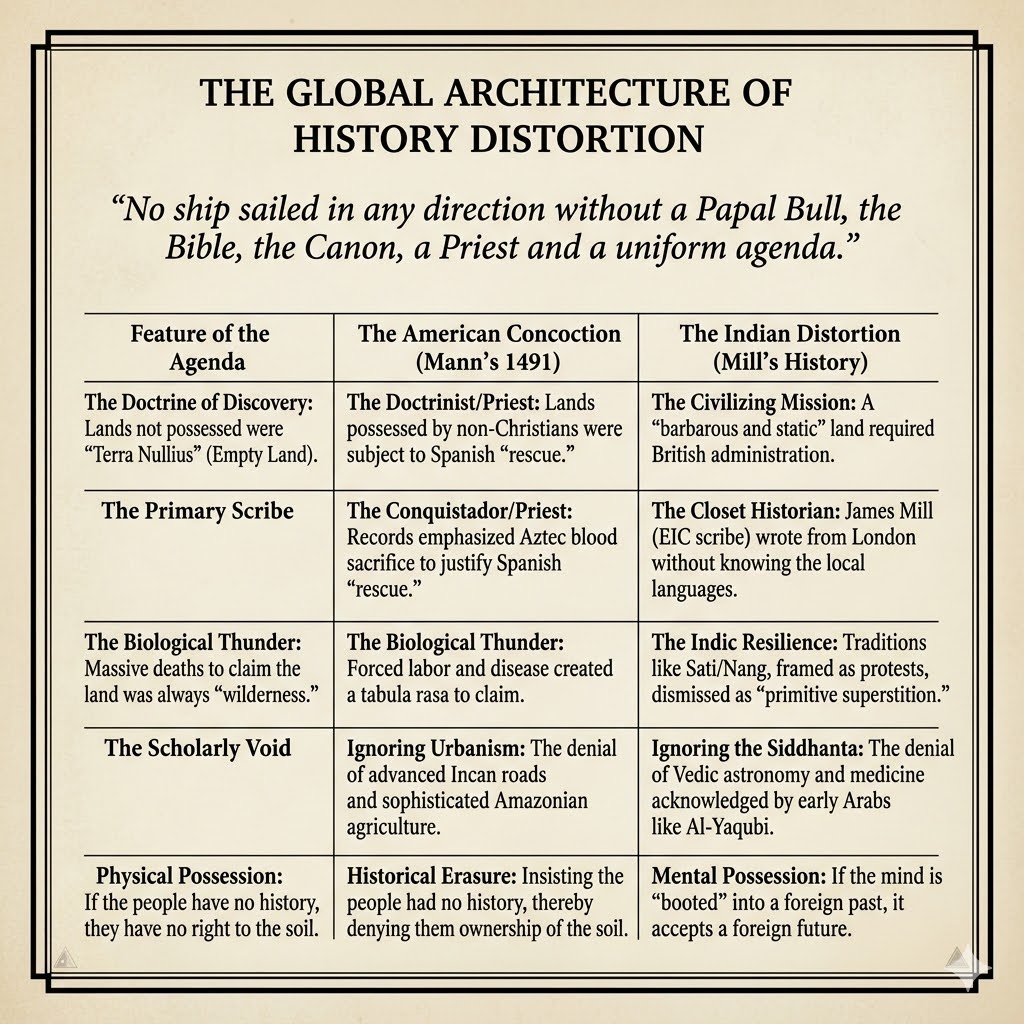
Whether through the fire of the Americas or the ‘Ice Cream’ of Mill’s history in Bharat, the goal was the same: to hollow out the indigenous soul and refill it with the requirements of the Cross.
Take the example of the Supreme sacrifices to safeguard the purity of progeny under Sharia law:
Sati for Hindus was Nang for Zoroastrians:
“What should have been recorded in the historical lexicon as ‘Indic Intellectual Resilience’—the ultimate rejection of a conqueror’s legal code—was systematically rebranded as ‘Barbarism’ by James Mill. As a salaried scribe for the East India Company, Mill required a ‘Barbaric’ India to justify a ‘Civilising’ Britain. Today, that Sati flattened into ‘Superstition’ by agenda-driven historians and Patriarchy by the leftist feminist nexus.
The Ultimate Refusal: Sati as Protest
Sati was more than a tragic end for a widow; it was the ultimate refusal to be processed by the “Desert Theocracy.” It was a defiant protest against the mandates of Surah Al-Anfal (8:41)—a rejection of becoming Ghanimah (الْغَنِيمَة), the “spoils of war,” or Fai’ (الْفَيْء), the wealth extracted without battle. By choosing the flame, they denied the conqueror his “heavenly right” to treat the non-believers’ bodies as a commodity.
We find this pattern of “Nang” (Honour) over “Ghanimah” across the path of the Muslim Invasion. Here are three pieces of evidence from Islamic scholars.
1. Muhammad Qasim “Firishta” (c. 1560–1620): In his Tarikh-i Firishta, he records the Battle of Peshawar (1008 CE) between Mahmud of Ghazni and Raja Anandapala. Firishta notes that the wives of the fallen Hindu warriors chose the pyre specifically to avoid the fate of becoming “Ghanimath ki Maal”—property to be distributed among the soldiers.
2. Abu al-Qasim Ferdowsi (c. 940–1020): Firdausi. In his epic Shahnameh (1010 CE), he preserves the memory of Zoroastrian women who chose death to protect their Sasanian “Farrah” (Divine Glory). Their concept of Nang (Honour/Shame) was a direct precursor to the Rajput concept of Jauhar. They would rather be consumed by the earth or fire than be “processed” as the wealth of the non-believer.
3. Ibn Battuta (1304–1368): Even the “Qazi of Delhi” could not remain indifferent to this act of refusal. In his Rihla, he records the sight of a “Kafir” woman mounting a horse, adorned in her finest garments as if for a wedding, only to dismount into a pit of fire.
The Persian Translation (The Courtly Record):
“سپس در آن گودال آتش افروختند… و آن زن بر اسب سوار شد و با فاخرترین جامه ها و عطرها خود را بیاراست… چون به آتش رسید، از اسب فرود آمد… و خود را در آن افکند… چنان حالم دگرگون شد که نزدیک بود از اسب فرو افتم.”
The English Translation:
“Then they kindled the fire in that pit… The woman mounted a horse, adorned with her finest garments and perfumes… When she reached the fire, she dismounted… and threw herself into it. At this, I was so overcome that I almost fell from my horse.”
4. The earliest Muslim Traveler in India writes differently:
The Persian and Arab Observation:
Ahmad ibn Abi Ya’qub al-Ya’qubi (d. c. 897 CE): An extensive traveller and chronicler, Ya’qubi journeyed through India, Egypt, and the Maghreb. His legacy is preserved in two seminal works: Kitab al-Buldan (The Book of Countries, c. 891 CE), a pioneering geographical text, and Tarikh al-Ya’qubi, a universal history. The first volume of his history provides an invaluable look at pre-Islamic civilisations, featuring a detailed section on the “Kings of India”. Sanskrit was an esteemed academic language among the Baghdad intelligentsia.
Image: Yaqu’bi
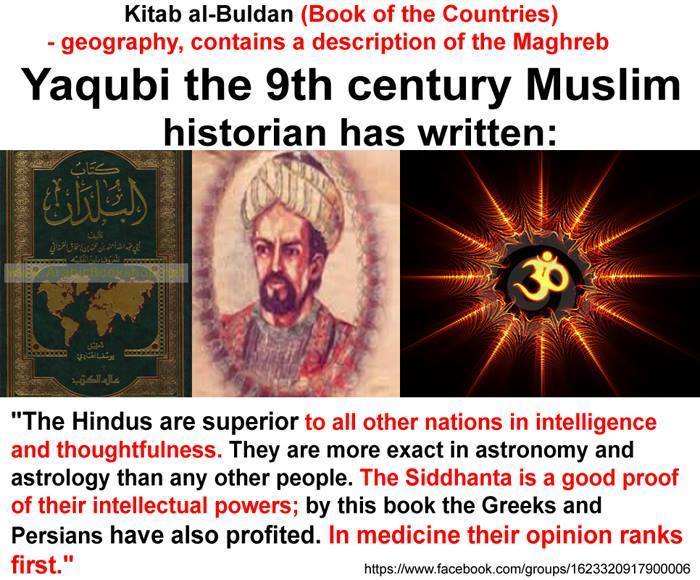
Ya’qubi recorded several key observations:
• He specifically lauded the Siddhanta, the ancient Indian astronomical treatise, as proof of Hindu intellectual brilliance. He noted that both the Greeks and the Persians had drawn significant scientific benefit from Indian astronomical knowledge.
• He acknowledged Indian medical science as paramount. He recorded those renowned Indian physicians, such as Manka Pandit.
• In Volume 1, under the chapter “The Kings of India” (Muluk al-Hind), he writes: “The Indians are the most advanced of all nations in the sciences of medicine and philosophy.
Source:
American Journal of Islam and Society got the books translated in 2017-2018. Available on The Book Gallery and INBNS.Net.
Pundit al-Hindi of Bagdad:
Manka Pandit: or (Mankah al-Hindi)*** find mention in Uyun al-Anba fi Tabaqat al-Atibba (Information on the Classes of Physicians) by Ibn Abi Usaibia (13th Century). It records: “Mankah the Indian was a scholar in the sciences of the Hindus… he cured Harun al-Rashid of a sickness that the physicians of Iraq could not treat”.
Manka was believed to be a Kashmiri scientist invited to Baghdad for treatment (770-710AD). Once in Baghdad, he settled there and became the director of the royal hospital. In the section on translations, Ibn al-Nadim lists the Indian books translated into Arabic and explicitly names “Mankah” as the translator of the Shushrud (Sushruta Samhita) from Sanskrit to Arabic.
***Reference:
• India and the Arab World by S. Maqbul Ahmad and New Age Islam.
• The History of India, as Told by Its Own Historians by H.M. Elliot and John Dowson (Vol. 1)
The above finding emphatically insists on a critical finding that pre –Islamic invaders / Travelers from central Asia, Greeks, China and Muslims of the Islamic Golden Age found Bharat as a land of science and philosophy, wealth (Gold) and hospitality, whereas the moment Indian rulers showed signs of weakness, looters invaded. Science then Hindus became dirty Kefir for Muslims, and history less Barbarian for Christians and in both cases India and Hindus are downgraded and demeaned by Invaders’ paid employed scribes as employed Kazi (Ibn Battuta) or scribe (James Mill).
The historical record reveals a calculated shift in the global “Gaze” toward Bharat. Early travellers from Greece to China, and scholars of the Islamic Golden Age such as Al-Yaqubi, recognised India as a land of paramount scientific, philosophical, and economic wealth. To these observers, Hindu brilliance was a source of enlightenment.
However, as political power shifted, the admirer was replaced by the looter, priests and clerics. Rulers’ employees replaced the scholarly observers, be it a Qazi (Ibn Battuta) or a Scribe (James Mill), with weaponised narratives. The Hindu was systematically rebranded: a “Dirty Kafir” to the Islamic legalist and a “History-less Barbarian” to the British colonialist.
Nobel Laureate Author V. S. Naipaul of Trinidad addressed India as ‘A Wounded Civilisation’ with a ‘shattered’ society and ‘mimic men’ of faltering identity. He then said, “India is the only country where people do not believe their own historians but rely on the colonial master’s version”.
If he is taken seriously, it becomes clear that from 711 AD to 2014, Hindu lives were subjected to either Abrahamic rule or Abrahamic narratives. ‘Narratives’ and ‘false history’ have mutilated the Hindu mind through intellectual atrocities more than physical or material restrictive measures.
Distortions of our Past are driving us to the destruction of our future.
Base reference:
- R.C. Majumdar (The History and Culture of the Indian People): Specifically, Vol II: The Age of Imperial Unity and Vol III: The Classical Age.
- Encyclopedia Britannica
 subhasmitra.co.in
You must be logged in to post a comment.