
Subhas Mitra: 26 March 2026
Karma-phaal distinguishes between wholesome and unwholesome deeds—those aligned with Dharma versus those that defy it—yet in either case, an outcome is certain. This leads to the Karma Chakra, or the ‘Wheel of Karma,’ the cyclical nature of existence driven by our actions and the subtle impressions they leave behind. Every action creates a ripple that must eventually return to its source to maintain the equilibrium of existence. Whether the result is immediate, gradual, or destined for posterity, the balance between action and reaction remains inevitable.
- Maharshi Kanad called it “कार्य्यविरोधि कर्म” (Kārya-virodhi karma) in the Vaisheshika Sutra (1.1.14), around the 6th–2nd century BCE, and Isaac Newton described it as his Third Law of Motion on 5 July 1687.
We can also compare Karma phal with the Domino Effect in physics, where a cascading progression occurs at 1.5 times its size. No matter how forcefully or how far you shoot an object upward, it has to return, but how soon or with what effect is hard to foretell.
Their effect is not limited to Hindu philosophy or physics but also applies to the Abrahamic Theocracy. The concept of Saved (Believers) and Fallen (Non-Believers) or Human vs Subhuman also has its return journey. Return path and course (Reaction) could be subjected to the Action’s origin, intention, planning, execution and purposes.
The Vedanta teaches us that flowers will not fall on you if you throw stones in the sky.
This book has enough discussion on the different traumas various invaders brought on Indic civilisation and their purposes. Sometimes it becomes very hard to decide whether a story is needed to keep history alive or whether, when it loses significance, history becomes a story.
“Explorers, conquerors, monarchs, politicians or academics each hold their own interpretations of events/history, but when it comes to a civilizational assessment, the meaning shifts. Politically, volumes have been written on the causes and effects of Pakistan’s creation; however, the lament of a wounded civilisation tells a much different story.”
As you sow, so shall you reap” is the essence of Karma-phala, but if money begets money, what does hate produce?
Hate (द्वेष) and Violence (हिंसा ) are potent elements that shape the human psyche. Dharmic traditions manage these forces strictly: a Sanatani is supposed to station them only as “security guards” at the gate of consciousness, or use them as tools for self-defence, and never allow them inside, whereas Buddhists advocate their total avoidance.
In contrast, Abrahamic frameworks have historically employed hate for exclusivity and violence for expansion. While Christianity eventually moved to constrain these impulses, a similar shift has yet to be embraced within Islam.
In India, the Muslim theocracy wanted Ghazw- a- Hind (turning India an Islamic state), but the British knew if Hindus adopted “Hate and Violence” it would never be possible; thus, they trained some Hindus and Muslims in their thoughts (brown Sahib), made the Muslim league (see Page ……), and trained Jinnah to weaken Hindus and divide India. The brand new British education was turning Hindus docile, patient and subservient to antagonistic ideas and taught them to be friendly with enemies. Some native converts, Christians, and communists also joined hands with Jinnah to break Bharat.
In a September 2019 interview in The Equator Line magazine, Mark Tully, a senior BBC journalist, said, “If all 73 firqa (sects) are living harmoniously anywhere in the world, it is in India and it is possible only because Hindus are in the majority (referring to his book ‘No Full Stop in India’ of 1991- reported Times of India.
Shia bodies like All India Shia Political Conference (AISPC), All India Azad Muslim Conference and Majlis-e-Ulema objected and protested against partition of India*** basically for fear of Sunni dominance. They appealed for minority status and propagated “composite nationalism,” believing that Hindus and Muslims shared a common history and homeland that should not be divided.
*** Qasmi, Ali Usman; Robb, Megan Eaton (2017). Muslims against the Muslim League: Critiques of the Idea of Pakistan. Cambridge University Press. p. 2. ISBN 9781108621236 and Wikipedia.
During the 1930s and 40s, Ahmad Yar Khan (Khan of Kalat), Khan Abdul Ghaffar Khan, and others formed the Kalat State National Party (KSNP), which strongly opposed the Two-Nation Theory and the partition of India on religious grounds.***
1919: Frontier Khan formed “The Khudai Khidmatgar “(Servants of God)
1930: his people were massacred at the Qissa Khwani Bazaar.
1947: He said to Congress, “You have thrown us to the wolves.”
1987: India awarded the Bharat Ratna (1987), India’s highest civilian honour.
A great saying of Al-Biruni’s Kitāb al-Hind went unheard: (see page….)
***Ref: https://sabrangindia.in/, .dawn.com/news/1236359 and Wikipedia.
Here are some ACTION and REACTION:
Some ACTIONS:
Durand line vs Chicken neck:
British policies in the Frontier Regions of India:
The smell of crude oil:
Crude oil was believed to have been discovered in Mesopotamia in the prehistoric era, but the Modern Oil Age began in 1859 with the drilling of the first oil well by Colonel Edwin Drake in the USA. Major Early Fields/wells came up in Texas in 1901 and in Arab in the 1930s.
T.E. Lawrence (1888–1935), or “Lawrence of Arabia”, was a military officer sent to Arab primarily to weaken the Ottoman Empire by consolidating Arab with Emir Faisal, a son of the Sharif of Mecca.
The same British deployed MK Gandhi to unite Indian Muslims in support of the Ottoman Caliphate, whom they had thrown out. Was it not for widening Hindu-Muslim enmity so that the British could prove to be Muslim-friendly to primarily Muslims around Afghanistan and Iran, i.e., the North-West Frontier Province (NWFP) or Khyber Pakhtunkhwa, that the North-West Frontier Province (NWFP) was established on 9 November 1901 by Lord Curzon?
This was done primarily to check USSR / communism but also to form a truce with Arab for searching for oil, and to create a buffer zone between British India and Afghanistan. It was an era of the “Frontier War”, the Malakand Rising of 1897, the Black Mountain Expeditions (1888, 1891, 1892), and the Durand Line, the first border between Afghanistan and India.
Winston Churchill arrived in India in the autumn of 1896 as a 22-year-old military officer and journalist of The Telegraph. He lived in Mumbai, Bengaluru and NWFP till 1899. When he became PM, the Bengal Famine and WWII happened. He was in opposition when the British were preparing to leave India.
Leopold Amery (Secretary of State for India), in his diary on 9 September 1942, wrote about: Churchill reportedly said:
“I hate Indians. They are a beastly people with a beastly religion… The Hindus are a foul race… I wish [Air Chief Marshal] Harris could send some of his surplus bombers to destroy them.”
Winston Churchill developed a love for Muslims during his NWFP days, which was rooted in a Victorian “Martial Race” theory, where he viewed the “warrior- uneducated” Muslims as a check against the “intellectual” Hindus whom he distrusted.
He said on 18 March 1931 at Albert Hall:
“While the Hindu elaborates his argument, the Muslim sharpens his sword.”
It won’t be out of context to say that the “Civilizational damage” Churchill and TB Macaulay have brought to Hindus far exceeds that of any colonial administrators or politicians of Britain.
Impression:
- This gives ample indication that the British could not hand over NEFA or the Seven Sisters, Baluchistan and Khyber Pakhtunkhwa to Pakistan, but helped them occupy both in the west, and the Seven Sisters remained incomplete.
- The British transferred power to India to a party presided by a Makkah-born Arab Muslim and to Pakistan by an Indian Gujrat-born Lohana convert, a Khoja Muslim of Sindh, whose grandfather was Poonja Gokuldas Meghji
- The Great Spy “Silver” of WWII arranged Netaji Subhas Chandra Bose’s 1941 Escape as guide RAHMAT KHAN. This Khan was none other than an Afghan-born Hindu from Swat Valley (now Pakistan) named Bhagat Ram Talwar (1908–1983),
Let us now look at the North East ‘Seven Sisters’ and the creation of the Chicken Neck:
Image : chicken Neck
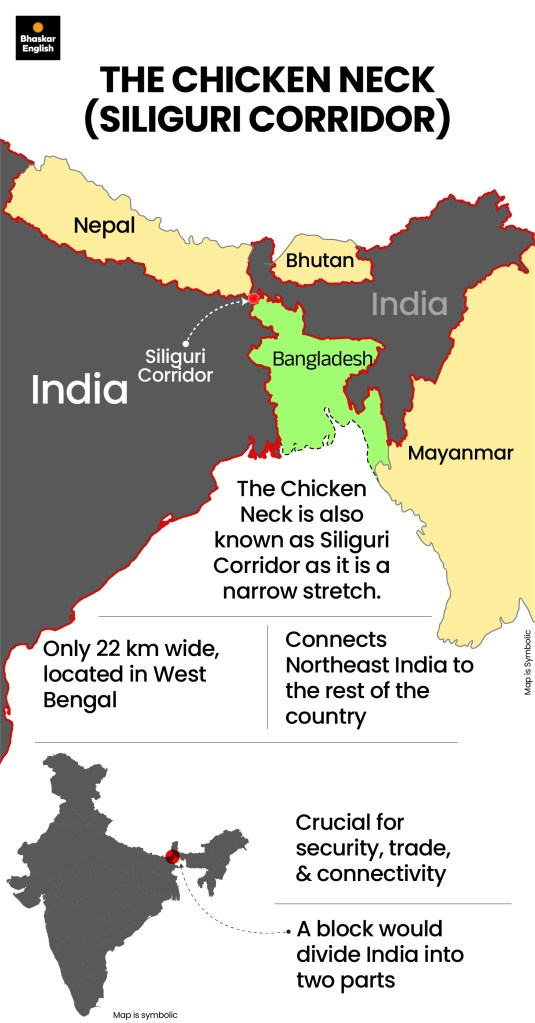
Two Christian missionaries, Fr. Nicolas-Michel Krick and Fr. Augustin-Étienne Bourry, from Madras, set out for Tibet in 1854 via Calcutta and Guwahati. While in the village of Somme of Lohit district near the Indo-Tibetan border, they were killed by a Mishmi tribal chief named Kaisha.*** Subsequently, the British, in February 1855, led by Lt. Eden, attacked Kaisha and killed him along with his three sons.
*** 1. Records of the Diocese of Miao: The local Catholic diocese in Arunachal Pradesh maintains historical records and has initiated the process of “Sainthood” for these two priests, who are referred to as the “First Martyrs of Arunachal.”
2. Relation d’un voyage au Tibet (1854) par Nicolas Krick
The British were not fools to ignore it. It’s simple to understand what led Nehru to project the Christian missionary “Verrier Elwin “as an anthropologist for conversion. He introduced the Inner Line Permit and permanently prevented the entry of Hindu Sadhus.
Chicken Neck in the map was part of the same GAME PLAN (not to forget Oil and Tea)
The details appear in “The Transfer of Power 1942–7″, Volume VIII (The Interim Government) > specifically: Document No. 457, “Note by Lord Wavell on the Breakdown Plan,” dated September 1946.
Lord Wavell (Viceroy- October 1943 to February 1947) on the Breakdown Plan, suggested British military control in the “contested” North-West and North-East (the future Pakistan) for a longer period.
The “Crude” Line: Wavell’s staff had already demarcated which districts in Punjab and Bengal were “Muslim-majority” and “non-Muslim majority” using the 1941 Census.
As per Field Marshal Viscount Wavell’s breakdown plan, NWFP and NEFA (Seven Sisters or SS) were to remain with the British even after granting dominion status (Freedom) to India and Pakistan, and accordingly, the crude line (Durand line & Chicken Neck) was drawn in 1941.
The fate of SS was decided at a meeting on Tuesday, 2 April 1946, at 12 noon, between the Cabinet Delegation, Field Marshal Viscount Wavell, and the Nawab of Mamdot.
Part-I
Here is the Transcription:
Cabinet Delegation Meeting Note (L/P&J/5/337: pp. 49–50) :
MR. QAIYUM said he would prefer to leave the discussion of the possible relations between the Eastern and Western Pakistan units, and Hindustan, to Mr Jinnah, although he could see nothing to prevent the two units from entering into a Treaty as equals. What the Muslim League objected to was subjection to a predominantly Hindu Centre, which would mean the extinction of Muslim rights.
SIR MOHAMMAD SA’ADULLAH agreed that the defence of the Frontiers in North-East and North-West India would be a matter for settlement between Pakistan and Hindustan. He referred to another Assamese minority, the Ahoms, and presented a memorandum on the subject. They, too, wanted separate electorates and safeguards and did not agree that the Congress represented their interests.
Part- II
Transcription: The Transfer of Power: 457: Sir N. Brook to Mr. Attlee
L/PO/12/2: ff 243–4: 5 June 1946: Page 91
4. (d) Mr Jinnah said that he and other members of the Working Committee were worried as to what would happen if the Muslim League accepted the proposals and the Congress did not. The Viceroy replied that he would brook no refusal from Congress and that if they decided against acceptance, he would hand over the interim government to the Muslim League and give them all the support they required. This very point was raised by some members in the Council meeting, and Mr Jinnah took them into confidence and gave the same reply.
H.E. saw the whole report on 7th June 1946.
Impression:
• Congress did not show enough activism/interest in retaining SS as an integral part of India.
• The league might have planned to take SS as they took NWFA and Baluchistan with the British consent or otherwise.
If Nobel Laureate Md. Yunus of Bangladesh talks of seven sisters; he was just giving lip service to the Old British military intelligence scripts via the USA.
Here is what a Pakistani author wrote about India’s intention on military dominance:
Maj Gen F M Khan *** (and several other Pakistani military strategists) expressed shock that India did not use its absolute military dominance in the East to permanently solve the “Siliguri Corridor” (Chicken’s Neck) vulnerability by annexing a strategic buffer from East Pakistani territory.( During 1971 war)
***Ref: “Pakistan’s Crisis in Leadership “by Major General Fazal Muqeem Khan (1973)
Who and how did the borders of New countries get drawn?
Wavell’s ‘Crude Line’ (Chicken Neck) was a year old when Redcliff arrived in India.
We are told our borderlines are Redcliff lines because it was drawn by British Law Lord Cyril John Radcliffe (1899-1977) who arrived in India for the FIRST time on 8 July 1947 and submitted his JOB SHEET on 12 August 1947 and The maps were formally revealed to the leaders of India and Pakistan on August 16, 1947, and were published to the public on August 17, 1947—two days after TWO countries were born with THRE E division.
NOTE:
The leader signed the Pakistan Creation documents, along with the Indian Independence Act 1947, without knowing its boundaries. These are the leaders Hindus are argued to worship as Freedom Fighters.
No Parliamentary Vote: The Radcliffe Line was never formally “accepted” or ratified via a vote in the Constituent Assembly.
Let it be Red, Blue, or Yellow ‘cliff‘, it is physically and geographically impossible for one man to map 450,000 square miles of complex territory in 36 days.
A country is being divided on political differences between Hindus and Muslim but the actual division is done through a judicial process where they have no access or a say.
Still, we are asked to believe that the Muslim League divided the country.
References:
Ref:
1. Borders and Conflict in South Asia by Lucy P. Chester: The author explores the “high politics” among Mountbatten, Nehru, and Radcliffe and specifically examines “political decisions disguised as judicial ones.”
2. The Great Partition: The Making of India and Pakistan by Yasmin Khan, a renowned historian from the University of Oxford, highlights the official incompetence and unseemly haste of the partition process.
1. The Fashioning of a Frontier: The Radcliffe Line and Bengal’s Border Landscape by Joya Chatterji, a Professor at Cambridge) focuses specifically on the Bengal Boundary Commission.
2. According to Freedom at Midnight (by Larry Collins and Dominique Lapierre) , the “Wavell Map”: before Mountbatten arrived, the previous Viceroy, Lord Wavell, had already drawn a “Breakdown Plan” map in 1946. This map bears a striking resemblance to the final Radcliffe Line. Many historians argue Radcliffe simply “refined” Wavell’s map rather than drawing one from scratch.
To unravel this, we have to look at:
The Chicken Neck and the “Great Game” theory:
Hindu-Muslim had nothing to do with the division of India. The theory suggests that as the British prepared to leave India, they faced a nightmare scenario: a united, independent India led by a “socialist-leaning” Congress (Nehru) that would likely remain neutral or friendly toward the USSR.
Was it the source of the KGB vs CIA (MI) role in free India’s politics?
To prevent this, the British “Deep State” (military and intelligence) sought to create a loyal buffer state in the Northwest:
Containment: A British-aligned Pakistan would provide airbases to monitor Soviet activity in Central Asia.
Oil Security: Pakistan would serve as a “sentinel” for the Persian Gulf and the Middle East oil fields.
The “Linchpin”: The port of Karachi was seen as vital to the British Navy’s control of the Indian Ocean.
What was the Wavell Plan (1946)?
While the 1945 “Wavell Plan” focused on executive council seats, the 1946 Breakdown Plan was the actual blueprint for Partition. Lord Wavell, a military man, realised the British could no longer govern India and proposed a phased withdrawal.
.
References:
A. The Shadow of the Great Game: The Untold Story of India’s Partition by Narendra Singh Sarila
The Premise: Sarila was an ADC to Lord Mountbatten. He discovered secret documents in the British archives showing that Partition was a deliberate British strategic move to create a “bulwark” against the Soviet Union.
B. Olaf Caroe’s Influence: Sir Olaf Caroe, the Foreign Secretary to the Government of India, wrote extensively (e.g., in his book Wells of Power) about how the “wells” (oil) of the Middle East needed a friendly Muslim power in the subcontinent to protect them.
Relevance: This is the strongest academic evidence that the “map” was driven by Cold War geopolitics rather than just communal “logic.”
C. Churchill and the Islamic World by Warren Dockter
The Premise: This book explores Churchill’s long-standing relationship with Islamic leaders and his belief that a Muslim state in the subcontinent would be more aligned with British imperial interests than a Hindu-majority India.
C. The Transfer of Power 1942–47 (Official British Records)
Some REACTIONS:
Pakistan was created.
By using religion as a tool of statecraft, the British “Deep State” committed a Ku-Karma (an original sin) in the creation of Pakistan. This was a geopolitical game plan driven by a hunger for Middle Eastern oil and the strategic containment of the USSR.
Now all stakeholders (UK, India, Pakistan, and Bangladesh) are in trouble.
There are details that make one question: did anyone expect the creation of Pakistan except the Muslim League?
The first Pakistani flag was hoisted in a University in CANADA.
Image: Instagram with caption
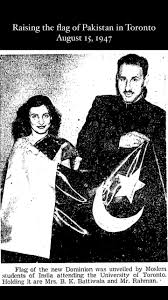
Caption: August 15, 1947. Location: Annesley Hall, Victoria University, within the University of Toronto. The caption identifies the individuals as Mrs B. K. Battiwala and Mr Rahmani.
14 August 1947: There was no Pakistan, but the Indian embassy in Paris organised the French-organised “World Scout Jamboree”.
What the ‘British Indian’ embassy did:
• They improvised the Pakistan flag (the Muslim League was not sure whether to make their flag available at all embassies or not be taken seriously).
• When the news reached Paris, Muslim scouts wanted to celebrate. Hindu students were gathered.
• Madan Mohan, a Hindu scout from Shimla, offered his turban to supply the green portion of the flag.
• Abbas Ali Gardezi, a Muslim scout from Multan, tore his shirt to supply the white portion.
• At dawn on 15 August 1947, the scouts held a small ceremony during which Dan Mal Mathur (a Hindu teacher from Ajmer convent) hoisted the improvised Pakistani flag,
• Muhammad Iqbal Qureshi raised the Indian flag
• Sarfaraz Ahmed Rafiqui hoisted the Scouts’ organisational flag.
ON 15TH AUGUST onwards, what was the condition OF HINDUS AND SIKHS IN PAKISTAN?
Answer: Near total elimination of non-Hindus from both Pakistan and Bangladesh, and an increase in the Muslim population in Hindu India and London.
What did Nehru’s newspaper report?
1. National Herald: When an Indian raised the Pakistani flag in Paris, and the turban of a Sikh was used to stitch it (Madan Mohan was a Sikh for Nehru’s secularism)
2. The Nation: Pakistan’s Flag and Its French Connection
3. The Times wrote: https://timesofindia.indiatimes.com/…/arti…/62123232.cms
Image of Pakistan parade:
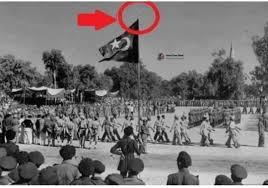
Caption: This Picture was taken on the 16th of August 1947, First Guard of Honour to the Governor General of Pakistan, Mr Muhammad Ali Jinaah, where the Pakistan National flag was mounted on “Panja Hazrat Ghazi Abbas” (پنجہ حضرت غازی عباس), which is referred to as a sacred religious symbol in Shia Islam.
Pakistan Govt. says it does not know where the FIRST flag was hoisted that day (as revealed on Wikipedia).
Image : First Flag
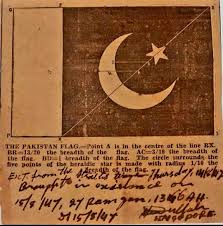
Caption :
The first Pakistani flag appears in Singapore, shared by a private citizen. The image appears to be a digital archival find (shared by an account like hassam. history on social media) of an original 1947 newspaper clipping.
Indian scene:
Image : Nehru Ji
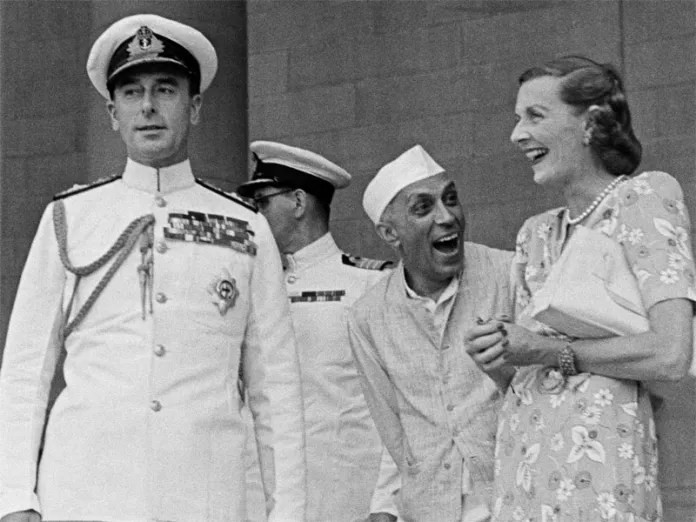
Caption : Date: August 15, 1947.
Location: The balcony of the Rashtrapati Bhavan (then known as Government House) in New Delhi.
.
How does the Sunni majority in Pakistan receive their dreamland?
Pakistan did not become what the British promised to Jinnah or what Jinnah promised to the people in his first speech to the senate. However, Pakistan has become what the British wanted it to be or what fundamentalists Ashrafis wanted it to become, i.e., the epicentre of global Islamic Terrorism that could destroy Hinduism in the hands of Ex-Hindus. They firmly believe ‘Hate and Violence’ is the only way of expansion and exclusive supremacy.
By now, we know what Pakistan has achieved so far, but we hardly know what Hate and violence have given to their leadership.
Mohamed Ali Jinnah:(25 December 1876 – 11 September 1948)
Jinnah suffered from lung TB that turned to cancer, and the Pakistan Govt. sent him to Zairat, a cold climate in Baluchistan, where his condition deteriorated to the extent that he could not sit up or move his hands. In this condition, he was brought to Karachi on 11 September 1848 at 4:15 PM, accompanied by his sister Fatima.
Father of the Nation, as well as sitting Governor General, but there was none to receive him except a military ambulance with attendants. Against Fatima’s will, he was being taken to his official residence, Guv House, rather than to the Hospital.
On the way, the ambulance ran out of fuel. It took hours to get another ambulance. By the time he was vomiting blood. A doctor was called, and Oxygen was advised. Two people went to bring the O2 but never came till he called Fatima to say “Fati- KHUDA HAFIJ ” and died at 10.25 PM.
His sister did Shia last rites while the Pakistan Govt. did Sunni rites.
Details from 4:15 PM to 10:25 PM are available in the book “My Brother” by Fatima Jinnah.
Earlier on 11 August 1947, He addressed people and said the Pakistan administration would have no role in religion. Hardcore Islamists in the party did not allow the speech to be published, yet on the 15th, he addressed the first senate to that effect.
Special Note:
Gandhi died; he said the Hindu leader had died.
When Jinnah died, there was widespread mourning in India.
His funeral procession had fewer people than our President APJ Abdul Kalam’s.
We just saw that UN-proscribed Terrorists are given state honours by their Army chief to UN-proscribed Indian terrorists sheltered in Pakistan.
In India, the Supreme Court opens at midnight to hear terrorists’ mercy petitions signed and fought by Hindus.
The court convicted and punished Yakub Memon’s funeral procession, which gathered 100 times more Muslims than that of APJ Abdul Kalam.
It is believed that this is the outcome of British education designed for Hindus and Muslims. For 800 years, there were no Islamic seminaries in India like “Deobandi” or “Barhelvi” until 1860. Although Mulla Nizamuddin Sihalwi standardised a curriculum called Dars-iNazimi in 1740, there was no British-standard Madrassa, as in the Madrasah-i-Aliah in 1780 in Calcutta.
Fatima Jinnah:
She was a Dentist from Calcutta and never wore a Hijab, for which she faced indignity and taunting. She was never allowed to talk publicly.
In 1951, she was permitted to talk on Pak Radio, but no sooner did she start speaking about her brother’s death and the ambulance incidents, than the broadcasting was put off.
She died in 1967. Her dead body was thrown out of the vehicle on the street by police, and the attendants were fired upon.
Note:
In the same Pak broadcasting, Pak Punjab-born Ustad Bade Golam Ali Khan was invited to a program. He was to render one of his most sung numbers in which the term “Hai Ram” is used (even today). However, the Pakistani authority ordered him to drop Hai Ram, and he returned to India and never went again until he died in Indian Hyderabad after living for years in Kolkata and Bombay.
Chaudhury Rahmat Ali :
A Gujjar Hindu convert, Jinnah’s trusted academic and motivational leader, who spoke of PAKISTAN in 1933 at Cambridge Univ. In 1947, he returned to Pakistan and gave a call to stop the killing of Hindus and Sikhs and send them to India.
He was arrested, had all his property confiscated, and was expelled from the country penniless. In 1851, an unclaimed “dead body” was found on a London street, which was identified as that of C Rahamat Ali.
Ref: Md. Ali Jinnah, the man behind the curtain by Dinkar Joshi
Liaqat Ali Khan :
First Pak PM signed a Pact with Nehru to safeguard minorities of each country in Delhi on 18 April 1950, which spoke of preventing forced conversion of Hindus in Pakistan and their property rights.
He wanted to end the JIHADI elements in the security forces. He was described as anti-Islamic and compelled out of office. He was publicly shot dead while speaking to the public in Rawalpindi.
Huseyn Shaheed Suhrawardy :
He was not only a hero of the Calcutta killing, but he was the brain behind making Jinnah acceptable to the Shia in the sunny world, as Bill Clinton, Obama and George Soros made Md. Yunus, a Munafiq (منافق), is considered an acceptable Jihadi for killing Hindus in Chittagong and Rangpur.
He became the 5th PM. He supported East Pakistan’s language demand, and that made him an apostate ( Murtadd). He was thrown out in 13 months and fled the country to Lebanon, where he died in 1963.
First Foreign Minister Zaffarullah Khan Ahmediea :
He invited all Ahmedias in Pakistan (as did Jogen Mandal). In 1953, his daughters were gang-raped and killed during anti-Ahmedia mayhem in Lahore. He, too, was forced out of the country.
Diwan Bahadur Satyaprakash Singh :
He was one of the 16 Christian supporters of Congress in Pakistan. He, too, asked all Christians to go to Pakistan, but the Church disagreed. Exactly the way the Church opposed the Citizenship Bill, as they did not want Christians from Islamic countries to come to India. It does not suit the conversion agenda of Hindus.
He was made Speaker of the Senate, which was objected to by Jihadists. He was asked to become Muslim, which he refused. Christian killing Jihad started in Lahore, where his daughters, too, were gang-raped. He resigned, and his death is a mystery, just like Dhiren Dutta of East Pakistan, whose dead body could not be found.
A unique pattern can be witnessed:
East Pakistan retained sweepers and Hindus from Andhra and other parts of East Pakistan.
West Pakistan retained all Christians and made them sweepers by reservation.
Sk Abdullah of J&K retained and invited Hindu sanitary workers from the mainland, but refused to grant them citizenship (Article 370).
References:
• My Brother” by Fatima Jinnah.
• Md. Ali Jinnah, the man behind the curtain by Dinkar Joshi
• Liaqat Ali and his time and work by Md. Reza Kazmi
• Jinnah, his successes, Failures and Role in History by Ishtiaq Ahmed
• With Quidi Azam during his last Das by Lt Col Dr Ilahi Baksh
What haunts London?
For two millennia, London has stood as the preeminent vertex of the West and a beacon for the global order. This is the city that shattered the chains of theocratic rule, bequeathing to humanity the Renaissance of thought, the rigor of modern academia, and the foundational blueprint for human rights and parliamentary democracy. From the revelation of gravity to the fires of the Industrial Revolution, London’s civilizational pride and spirit of tolerance served as the bedrock of the modern age.
Having historically integrated its colonial subjects into a framework of equal opportunity and citizenship, the city now finds itself at an existential crossroads. What are the true consequences of the recent surge in illegal migration? As these ancient foundations shift, who suffers most, and toward what destination is the current ‘solution’ drifting? Perhaps the hour has struck to look back at the ‘Jewel in the Crown’—to scrutinise how subjects were once governed and whether those historical fault lines are resurfacing to haunt the present. We must ultimately ask: can a civilisation survive if it remains indiscriminate in its perception and protections, or will a lack of historical justification prove fatal to its future?”
 subhasmitra.co.in