Subhas Mitra: 02 Oct 2026
No matter how much I learn, I fail to understand why Hindus of Bengal do these:
• Kick and burn the OUM ॐ Symbol at educational institutes
• Kick and tear images of Vivekananda
• Breaks vast of Iswarchandra Vidyanagar
• Kick and burn Baba Bageswar images
• Eats Beef in public and is afraid of taking the name of Pork
• Do not condemn when Muslims break the statue of Rabindranath Thakur
• They cannot make a movie without insulting Hindu deities and rituals.
• Do not dare to condemn perpetrators of the Calcutta Killing & Noakhali. Even Gopal Patha’s descendants are afraid to portray him as the “saviour of Hindus”.
• They trust Pakistan, Urdu and Muslims more than Hindus and Hindi of central India.
In searching its roots, I have written 2 books: “India Beyond Narratives” and “Rebooting The Hindu Mind”.
Today I wish to talk about the non-academic brainwashing machine i.e.
- Cricket and
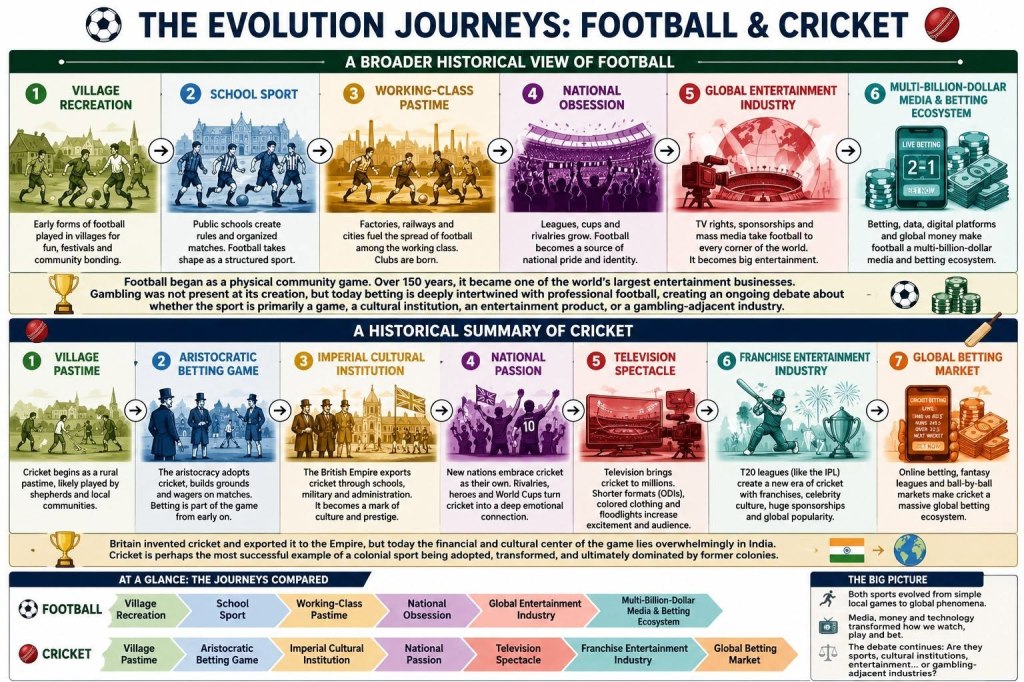
Cricket, a Whiteman’s sunbath pleasure game, became a billion-dollar gambling, colonial hangover/legacy and marketing and Advertisement Empire.
• Movie.
Let’s focus on mainstream movie in India.
Bioscope, talkies and cinema entered India from Calcutta by the East India Co made English Hindus of the Brahmo Samaj or crypto- Christians. Even after the partition bloodbath, Bengali movies were made to vilify Hindu deities with intellectual humour in the 1950s itself.
• Hiralal Sen made the first Talkies (Ali Baba Chalis Chor – He could not find a story in 10K year old civilization)
• Dadasaheb Phalke made : Satyavadi Harishchandra
• Mehboob Khan’s : “Al Hilal” (Judgment of Allah)
Note: Hindu and Muslim movies (i.e., Hindi-Urdu) were being made, and audiences received them well. Because of MK Gandhi’s Khalafat and the Muslim League’s Hindu killing, many Muslims adopted Hindu names in public life in India.
The details: https://subhasmitra.wordpress.com/wp-admin/post.php?post=876&action=edit
Presumably, our PM had a better idea to use the platform as mass communication to attract less educated or aware youth towards anti-idolatry and a polytheist Abrahamic long-term agenda in the minds of Hindus. Congress tried to leave the South for the DMK, the Northeast to the Church, Bengal to the Communists, etc. and win elections through propaganda, including in the movies.
The disease of secularism in movies enters through FTII.
Historians worldwide have shown that India exported men (migration out) and materials (metals, chemicals, medicines, and textiles), and also Kama Sutra, the world’s first such book, before becoming a colony. But when freedom was achieved, our leaders felt that “imitating the Abrahamic” alone would make them compatible.
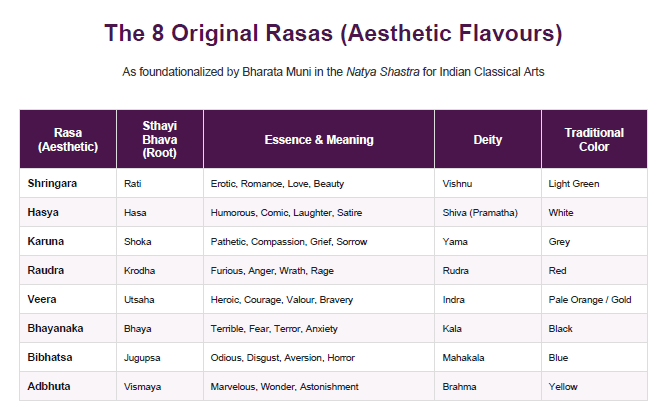
Our various RASAS are said to be older than the Greek tradition. When Kalidasa wrote, Shakespeare had not yet been born. Yet, when FTII was formed, they needed a French connection?
People who knew Bharat did not have entry into CLUB CONGRESS.
Thus, FTII came into existence with Muslim intellectuals and leftist teachers in 1964. Bengal and Keralam sold Hindu superstition, negativity and poverty all over world with style and artistic presentation. Tamil, Telugu, and Kannada movies were kept away from the rest of the Indian Hindu audiences through engineered distance created through language and ridiculing southern traditions in Bombay cinema.
Meanwhile, Hindi film became an Urdu movie to Islamize the Hindu mind via “inculturation and Da’wah”, of which Hindu youth knew or know nothing.
Here is a brief of FTII:
The intellectual and institutional origins of India’s Film Institute come from IDHEC (Institut des Hautes Études Cinématographiques), which was established in Paris in 1943, during the German occupation of France, by filmmaker Marcel L’Herbier and with the support of Louis-Émile Galey, Director-General of Cinematography under the Vichy government. (Vichy was a French authoritarian, nationalist and socially conservative regime that collaborated with Nazi Germany) .
L’Herbier was a socialist by orientation, and his objective was to establish film-training institutions as part of Vichy’s wider reorganisation of French cinema. (Experts find the role of ‘for & against’ propaganda promoted through film).
The connection with India is well documented after its rise in Parliament. The FTII was “to a large extent patterned on the teaching programme followed at IDHEC, Paris.” IDHEC Director Rémy Tessonneau visited Pune in March 1961 and prepared the draft outline for five principal courses.
Role of Nehru JI:
Perhaps Nehru Ji thought of reaching the heart and mind of the last person in society through mass communication and entertainment. In 1960, FTII (Film and Television Institute) was formed, and two successive heads were:
- Anwar Jamal Kidwai and
- SMH Burney
Both were Urdu-speaking propagators of the two-nation theory from AMU & Jamia Millia, with nothing to do with arts, theatre, drama, or creativity. FTII, like AMU and Jamia, does not follow Indian constitutional guidelines on reservation. They brought the Islamization of our films and facilitated leftists to take over to give a Hindu look and be defined as secular.
Gajendra Chauhan took over from Saeed Akhtar Mirza, a Sufi, communist, Urdu intellectual, projected as a “Hindi” storyteller.
As the FTII matured by the 1970s, “Hindi” filmmaking has been systematically shifted to Urdu, and hardly anyone noticed the changes that are eating into the heads of gullible Hindus and nationalists.
This Islamic Urdu in the “masses” and Evangelical English in the “elite” prevent us from taking pride in our past and developing love for the nation & its unique coexistence in diversity. Until more people are patriotic, our dream of a rightful place/supremacy in the league of nations will remain only a wish.
Urdu:
1206 AD Muslim rulers decided to make a native language for administrative use by Ashraf (foreign Muslims), which became a fact in 1837 (official language for court, military barracks, baiji kotha (court of dancing girls etc.) By 1857, Ajlafs (pan-India native converts) were included /permitted to use Urdu. In the 1880s, afsana (fiction) writing began, mostly by Persian thinkers. 1906: Muslim League formed, and Urdu is forced on Native converts (Ajlaf – Arjal- Pachmanda). The sole motive was to de-Indianize (The evangelical term is: “Rigour de Misericordia”) the converts and prevail over the Kafir’s imagination by emotional infiltration or implantation.
Hindi:
In the 1900s, a language named HINDI was shaped as if there had been no common language in central India before the British. So the British gave the Hindi language with overbearing insertion of Persian vocabulary (even today news readers use Urdu-mixed Hindi).
New language:
Churches, on the other hand, manufactured new languages in India, with Roman scripts replacing indigenous scripts in the entire NE- Tripura and tribal Odisha-Jharkhand.
Secularism in Filmdom:
From the formation of “FTII” until the dubbing of South Indian films into “Hindi” (Urdu) became common, the standard taglines of Mumbai films were:
- The Hindu hero is an atheist who insults Hinduism.
- Every Muslim character is pious and helps Hindus.
- Every villain is a Hindu Thakur.
- An educated person is only a church figure.
- Every characterless cheater and womaniser is a Hindu Brahmin.
- Every Hindu ashram is a den of smuggling, drug trafficking, and other illegal activities.
- In some movies, a Pujari is shown as ignorant, superstitious, and discriminatory.
- A Muslim is a very honest friend of Hindus and mingles with Hindu families.
- But you never find a Hindu inside a Muslim household.
- Last but not least: a Muslim child in a hijab inside the home and on the dining table ( you never find such a scene in Pakistani or Bangladeshi movies or on TV, but only in India).
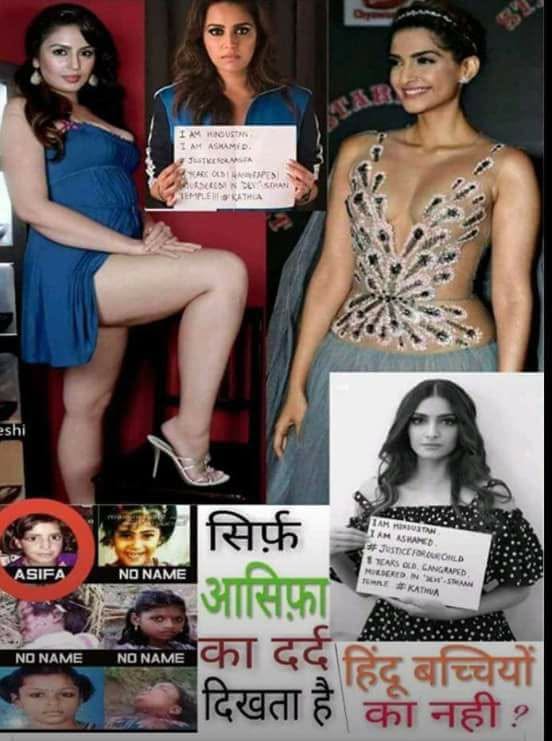
Now look at the image of Islamized Hindu film personalities and think about whom we should blame for their cry over the false rape of a Muslim girl in J&K, but carelessness about the actual kidnapping and rape of a Hindu girl in Delhi.